
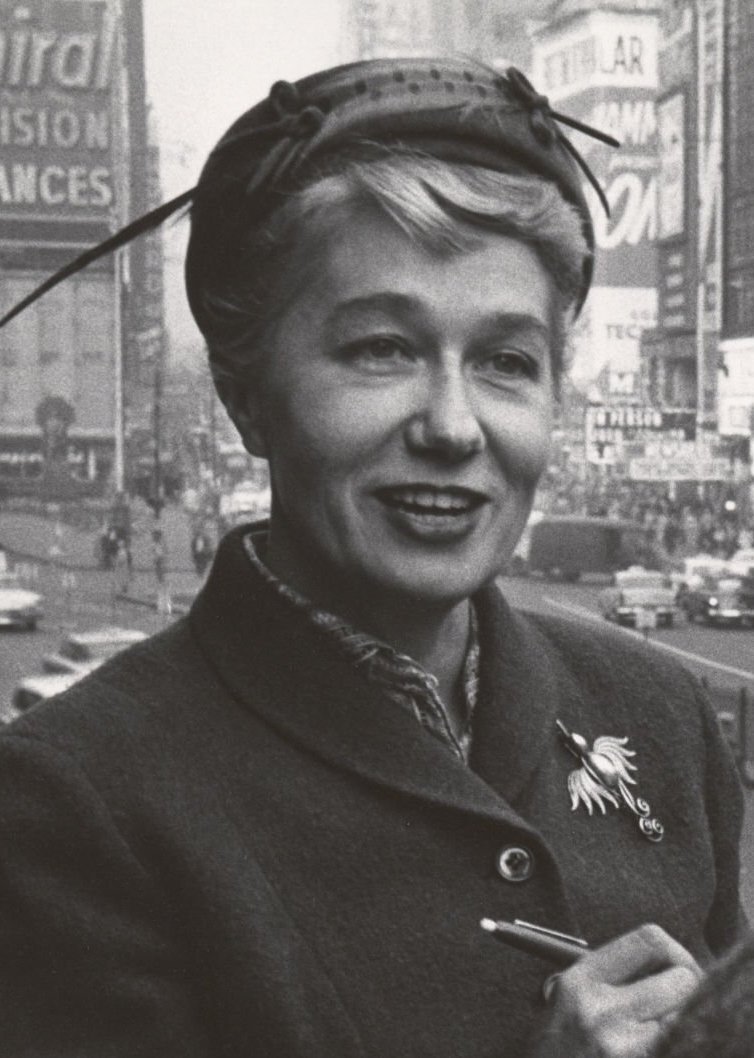
Washington Press Club Foundation

Edith Evans Asbury: Interview #1

August 8, 1988 in

Kathleen Currie, Interviewer

Edith Evans Asbury August 08, 1988 Tape 1 of 2

August 8th, 1988
Listen to audio

Edith Evans Asbury August 08, 1988 Tape 2 of 2

August 8th, 1988
Listen to audio

Edith Evans Asbury August 08, 1988 Tape 1 of 2

August 8th, 1988
Listen to audio

Edith Evans Asbury August 08, 1988 Tape 2 of 2

August 8th, 1988
Listen to audio

Edith Evans Asbury August 08, 1988 Tape 1 of 1

August 8th, 1988
Listen to audio
Page 1

Interview #1, Part 1

[Tape 12_01 begins]

Currie: Let’s start with a little bit about your family, your background, and where you were

born. What year?

Asbury: I was born June 30th, 1910, in a little town called New Boston, Ohio in a house on the

land that my grandparents owned. It was a little house in the back, into which my parents had

moved after they got married almost exactly nine months before I was born.

They were in this little house because my grandparents were very much against the marriage and

disliked my father very much. They were only there two months. When I was two months old,

we moved to Cincinnati. When I later asked my father why we moved, he said that my

grandparents were minding his business too much. Of course, they were concerned with their

daughter.

So, I really grew up in Cincinnati. New Boston is just outside Portsmouth, and I guess it's about a

hundred miles from Cincinnati. It's just across the river from Wheeling, West Virginia, where

there was a big steel mill. It was a little place where you had a house with a garden and a cow

and pigs and chickens, although it was a town. A lot of the men worked in the Wheeling Steel

Mill.

Wheeling, West Virginia was real near the hillbilly West Virginians that lived back in hollows

and so forth. That's where my father came from, those Virginia hollows, which is one reason my

grandparents didn't like him - because they thought him an uncouth hillbilly. Most of this I found

out on my own by listening to my aunts and uncles, who also didn't care a lot about him My

mother had one child after another after another, and she was too busy to ever talk to me very

much.

Currie: How many children did she have?

Asbury: I really would have to stop and count them up because some of them died when they

were babies. It was a great source of dissatisfaction to me because, being the oldest, I had to take

care of them. They were a lot of work. They were a lot of nuisance too, because when I got into

my teens, they would yank open dresser drawers, throw things all around, and come and pester

me when I was trying to do homework. I never felt romantic about babies because I saw too

many and too much of them.

To get back to my parents -there was a shoe factory, Selby's Shoes and I think they met there. I

think that she was working on a machine that made heels on shoes, because once, I guess she felt

guilty about never having time to talk to me, or wanted some sort of companionship that she

practically never had, so she sat me down and explained how shoes are made. She explained to

me that to make heels, you glue layers of leather together. They don't do that anymore. Now, they

paste a thing on there that imitates layered leather. Somewhere, I got the impression that my

father worked there as a supervisor.

Anyway, my grandmother had this wide porch across the house, and there was a swing on the

end of it. My grandfather was a great big, burly, red-faced guy and the redness may have come

from liquor - I don't know. There were a lot of alcoholics among the people in the family, as I

now understand. That may be why he was always very jolly, like Santa Claus.

My grandmother was a little, tiny woman with pinched lips. They used to call her “queer

turned.” Maybe he was always drinking, and she had to cope with it. I don't really know, but she

was not a warm person, and she was sort of withdrawn.

Currie: “Queer turned?”

Asbury: Well, they called it “queer turned” because what it really was is taciturn, I think. There

was nothing wrong with their brain. It was just that she was not a warm, jolly person. She was

not a disapproving, she was just withdrawn.

Currie: These are your mother’s parents?

Asbury: My mother's parents - my grandfather had teams of horses that they rented to the steel

mill. These horses dragged some sort of platform moving big vats of molten steel from one

furnace to another. Mind you, this is 1910. In this very rural place, he was sort of a man of some

property. He had these horses that he rented out.

My grandmother had four daughters, I think. Let’s see - there was Selma, Rose …well, she had a

bunch of daughters and sons. Two of the sons were close to my age - one was older, and one was

younger. They were little terrors and made my life miserable when I went up there to visit. I used

to be sent up there alone to visit sometimes when my mother was going to have a baby because I

was so nosy. They didn't want me to learn what it was all about.

In those days, people had babies at home. Once, they didn't get me away fast enough. This baby

was born while I was around the house, and my mother was in the bedroom moaning. This

distressed me very much - to have an adult, especially my mother in pain. Somebody - I don't

know who - told me to go next door and get the neighbor. I went next door and got the neighbor

and she came and she said, “Why didn't they tell me? Why didn't they tell me? Why didn't they

tell me.” I suppose she meant, “Why didn't they tell me I was going to be stuck with this?” I

don't know.

Of course, I was all eyes and ears. Then the doctor came, and I heard my mother moaning some

more and then I heard this wail of a baby. I couldn't quite put it together. Before the wail of the

baby, the doctor came dashing out and said to get some hot water. I guess the neighbor put the

tea kettle on. I looked at her and I said, “What's the matter with my mother?” She said, “Don't

bother me too much.” I said, “Has she got a stomach ache?” - because that's the only ailment I

ever had. She just stopped in her tracks and glared at me. She thought I was having her on. I

didn't know what I was asking

Currie: At what age?

Asbury: I said, “Has she got a stomach ache?” I was maybe seven. Later on, in this bedroom –

where, of course I was not allowed - I heard the wail of a baby. I rolled this over in my mind. I

couldn't quite put this together.

There was a new boy in school. I was in the third or fourth grade and that would make me nine

or ten. Everybody was whispering about this new boy - where did he come from? The rumor was

he had come from New York. To us, having someone from New York in our school was as if E.T.

had arrived from outer space. It was unbelievable.

In one of these classrooms, I sat behind him and I poked him on the shoulder and he turned

around and I said, “Where did you come from?” He looked at me and he said, “Where did we all

come from?” Then he turned back around. He was nasty. I was thinking about that. Then I

remembered we had this great big medical book, at home, the kind you got by saving coffee

coupons. Once you got enough, you sent away and you got this big medical encyclopedia and

this big dictionary. These are churning in my mind and I remembered something that I had seen

in that medical book that I had not understood at all at the time. It was a human body and you

folded it out and saw the skin with the nipples, and then you folded out the ribs and then you

folded it out and you got deeper inside. There was this little circle that looked like a little human

being rolled in a ball. I couldn't understand what the heck it was. It wasn't specifically formed

enough for me to say, “Yes, that's a baby.” Now, I'm putting two and two and two together and

I'm figuring out what this is all about. That's how I learned the facts of life - I had to piece it all

together by myself, because in those days, things like that were not discussed, at least not where I

came from.

They would send me off to my grandmother’s because I was always very nosy, always asking

questions and it was bothersome. I'm sure I was a pest. They used to call me “Little Miss

Question Box” or “Little Question Mark.”

To get back to, my grandparents, sometimes, the whole family would go up there - a hundred

miles wasn't so far away. This is before cars were generally owned, but usually somebody in the

family had one of these big old things, or you went on a train. Once, when I was up there,

everybody decided to go and visit my great-grandmother. We were going to make a picnic of it.

She lived way out in the country, and I guess they didn't visit her very often. She was my

grandfather’s mother and was about 92 years old at the time. I was quite young, just a child. I

remember her as jolly, pleasant, and active.

She had a flower garden with little, old-fashioned, hard-petaled zinnias of different colors and

dahlias in a vase. She brought out teacups with black walnuts, which are hard to get out of the

shell and served them. While we were there, she got out a trunk and had these things she tried to

show me. But I wasn't interested. I didn't pay much attention to her, which I regret, now.

Later , I learned that she had come down there at the age of two from Pennsylvania. There was

some kind of a cult in Pennsylvania where her family lived, and this furor had risen up and

ordered that men and women could no longer live together. They built houses with separate

dormitories - men in one section, women in another.

Her parents said, “The hell with this,” in effect and they built a raft and marched the cows, the

pigs, and the chickens onto this raft and went down the Ohio River to Scioto County - where

Louis Bromfield later lived and wrote about. When they arrived, they marched the cows, the

pigs, and the chickens off the raft, took the logs from the raft, and built a cabin. She had

remained on that same land ever since.

Currie: She’d been there all her life?

Asbury: All her life. Yes. When she grew up and married, she moved into her own little house

on that property. But I paid no attention to her stories. I can still picture her and I can kick myself

for not paying more attention to her. But I was just a kid uninterested interested in old people.

Still, she was very pleasant. I remember she was a warm person. She was my grandfather's

mother.

These two little monsters made my life miserable. They were mean little boys, one older and one

younger than me.

Currie: They were your uncles?

Asbury: They were my uncles and I guess they were jealous of this baby. You see, I was the first

grandchild of both grandparents, and both of my grandmothers were named Florence, which is

why my middle name is Florence. I guess the one who was a couple of years older than me had

been the darling of the clan, and then this new baby appears - this first grandchild, a little girl.

They say that when I was a baby - well, first, I have to tell you that as I said, in that era and in

that strata of society, babies were born at home. You can imagine all the excitement with my

grandparents, my aunts and everybody gathered around for this new baby being born in this

house behind the main house. In the excitement, nobody noticed that this little boy, my uncle,

who was a couple of years older than me, saw the whole thing.

The way they found out was that when I arrived, some of the kids – maybe cousins – were

asking, “Where did she come from? Where did she come from?” He was told that they sent away

for me with Arbuckle Coffee coupons. That's how people got the medical books and the

dictionaries and everything - using Arbuckle Company coupons. But this little boy said, “Oh no,

that's not the way it was. I know where she came from.” They were just horrified, because he'd

been there under foot, and nobody paid any attention to him. Imagine a two-year-old or three-

year-old boy seeing this. He said, “Oh no, that's not where she came from. I saw where she came

from.” You can see life was pretty elemental around there.

How those little brats tortured me.

When I was up there by myself, it was two little brats against one for one thing, and they were

always picking on me. I would complain to my grandmother, but she wasn't interested in my

complaint. After all, the two little boys were hers and I was an interloper. Maybe she wasn't very

happy being stuck with me anyhow, probably furious that my mother was having another baby.

One time, they complained about me doing something - I don't know what it was - and for

punishment, she locked me up in the spring house. Now, the spring house is a cool place where

they store things to keep cool. I guess it's a house built over a spring.

Currie: Was it made of stone or wood?

Asbury: I don't remember, but I do remember being locked inside while they were outside,

peering through a barred door and taunting me, “Yeah, yeah, yeah, yeah, yeah.” Then I found a

barrel of apples in there. I took out the apples and I was eating one and saying,” Yeah, yeah,

yeah.” That made them furious, because I was eating apples and they couldn't get at the apples.

They went in and complained to my grandmother. She came out, released me and locked the

door so none of us could get the apples.

Currie: Now, did they object to your father marrying your mother, because they thought he was

from a different class?

Asbury: He was partly from a different class, and I gather he was a pretty smart-aleck young

man. I never liked him myself after I grew up and could analyze him as an adult. He was an

unknown quantity, and whether he talked about his background or not, he was a hillbilly from

West Virginia. When I was older, I was always very nosy. One day, I was rummaging around

some dresser drawers, I found some pictures of him - sort of professional brown-and-white

photographs. In one, he was walking a tightrope. He had been some sort of a performer. Then I

found another picture of him and he looked like a pugilist. He'd been various things and was

probably an adventurous type. I think he worked on a showboat for a while. He was not the type

that a rural family would want to marry their daughter. As it turned out, he didn't do any of those

things afterwards. He worked but, he wasn't very skillful. He never made much money, and he

kept my mother pregnant all the time. He was unable to provide properly.

Currie: What kind of jobs did he do?

Asbury: They were just ordinary jobs. Once, he was a streetcar conductor. Another time, he was

a cashier someplace. At one point, he made radio cabinets when radios came in and sold them.

Sometimes he was a carpenter, but he really had no skills or education to speak of.

He was an egotist. He didn’t have any great feeling of responsibility, or they wouldn't have had

all those children. My mother was mad about him. She was just crazy about him. I feel terrible

now that once I balled her out. I asked, “Why in the world did you marry him?” She said, “Don't

speak like that about your father.” Once, when I went up there to visit, somebody told me that

she had an acceptable boyfriend before my father came dashing in. I said, “Why didn't you marry

so-and-so?” She was just enraged. “You can't talk like this about your father,” she said. I said,

“Well, you chose him. I didn't.” I feel terrible about it now, but at the time, I was so outraged at

everything that was going on. By then, I guess I was in high school and on the verge of taking

flight. As a child, I was his favorite daughter. I guess I was like a little pet - well, yes, I was a

little pet. He took me places. He took me to the theater and vaudeville - places he should have

been taking my mother.

Currie: You and your father would go places?

Asbury: Yes, yes. She was home taking care of the children. Of course, that was just delightful

for me. I guess he was taking me to keep anybody from complaining about his going alone. I

don't know why, but anyway, he took me to these various things, and I thought it was wonderful.

When we'd be sitting around, he'd take delight in all my questioning because he could answer

them. But when I got into my teens and I began to look at the world with a more critical eye –

when I was no longer his little pet and began to assert myself - he tried to cow me. We almost

came to blows then. Also, I didn’t like what he was doing to her.

When I was in high school, we never had any money. I did everything I could to earn money. I

was away from home most of the time because I had to work after school. I worked in a bakery

part-time. I went there after school and I'd stay till 10:00 pm. I worked for six hours for $0.25 an

hour. This was marvelous. I was delighted when a holiday came because then I could work eight

hours all day. The first job I had was babysitting for a widow who had two little kids - and what

mean little brats they were! I was taking care of the house and taking care of them until she got

home, and then I worked at the bakery.

We moved across the city limits of Cincinnati, and because we were outside the city limits, I

could no longer go to the very special high school I had been attending. Suddenly, I had to go to

this country high school, where all 12 grades were in one building. There were only about ten

students in the whole high school. In the second year of Latin you get Caesar, the third year you

get Cicero and then the fourth year you get Virgil. That was the standard sequence. I moved there

when I should have gotten Cicero, but that year, they were not offering Cicero - they were

offering Virgil instead. I had to take Virgil, and I just had a terrible time. I wasn't ready for it, and

I hated it. I felt so above this rural school.

When I was in the sixth grade, the war had just ended, and during the war, they had developed

the Binet Intelligence Test for soldiers. It was the first intelligence test. Cincinnati was very

advanced in a lot of things, including education. They decided to administer the Binet Test

citywide to children in the sixth grade. They would pick two students from each school to go to a

special junior high school. Junior high schools were new at the time.

I was not a model student at all. I was always playing pranks, passing notes - something like that.

I didn't adapt to discipline. I still don't. [Laughter] I can go along with it when necessary, but

some of it seemed highly unnecessary, I guess I was always a rebel at heart, and I liked to flout

things if I could. The two people who got the highest mark in this citywide Binet Test in my

school were me and the son of the local butcher. The principal - his name was Mr. Hoffa - was a

great, big, heavyset man, built like a barrel. He was tall, formidable, and very cool toward me.

He had to send for me. When I went in, he told me that I had scored high on the test and could go

to this very special school. I just looked at him in amazement. I thought he sent for me for some

kind of discipline, because that's the only time I ever went in there. I couldn't believe what I was

hearing.

There was a model student in my class. Her name was Marie Grimes. She did everything right.

She got A’s, was always neat and tidy, and all the teachers just loved her. I thought she was a pill.

When he told me the results, I said, “What about Marie Grimes?” He winced, as if I were

rubbing salt into a wound, because I'm sure that's what he thought, “What about Marie Grimes?”

She would have been his selection to go to that school. But there we were at this special school,

having these very interesting classes – and taking Latin in the seventh grade.

Currie: Was that your choice?

Asbury: That was the curriculum. This was an experimental program. I was there for three

years. I had three years of Latin, and I thought I was something. We had wonderful teachers there

and wonderful classes. This was a special thing. There were a lot of kids there with funny names

like Roginsky, Schwartz, Klein, and Cohen. I found out they were Jewish, and I was amazed.

You know, I thought Jews were monsters.

Currie: Why did you think that?

Asbury: That's what I was taught. I grew up in Ku Klux Klan territory. I was only about 100

miles from Indianapolis, which was a capital of the Ku Klux Klan, a formidable national

organization at that time. You got it with your mother's milk - the Jews, Catholics, and niggers

were beyond the pale. I discovered that these Jewish kids were human beings, just like I was. It

was a revelation. Of course, they were the bright ones that passed in the other schools because

they had families that traditionally would make them study.

Anyhow, it was wonderful being at that school, but it was a long, long trolley ride to go there.

When we moved over the border, I had to go to this little country school. This little country

school had a principal named Robert Kenneth Salisbury. He was a very shy person, wore horn-

rimmed glasses, and he taught mathematics and algebra. I think this may have been his first year

there - I don't know.

Anyhow, I was sent to his office to be reprimanded once for passing a note in study hall. I got

there, he had a bookcase full of Mark Twain books. He wasn't around. I opened the bookcase and

took out this Mark Twain book was looking at it and he strolled in and he said, “You like Mark

Twain?” I said, “Yes.” So we had a long talk about Mark Twain and then the bell rang and he

went to class. [Laughter] He thought I just stopped in to see his books. I guess the teacher who

sent me there later asked what he did, and that's when he found out why I was in there. He sent

for me and when I got there, he said, “Why didn't you tell me you'd been sent in here?” I said,

“You didn't ask me, and besides, I didn't want to spoil a nice conversation.” Well, we bonded,

you know, subterraneanly (sic), we bonded. There was really no outward evidence, but I knew he

was taken with me, and I was taken with the fact that he had had a friendly conversation with me

the first time I went there.

He rode home on the same interurban that the rest of us rode home on, and the kids made fun of

him because of these glasses and because he was so shy. He tried to be tough and he made a

speech in study hall one day in which he was explaining that somebody had stolen a paring knife

from the cafeteria. I don't know why everybody was so outraged that the paring knife had been

stolen, but they were. He gave a lecture and said, “If you'll steal a paring knife, you'll steal

anything. You must not steal.” He said, “If I find out who it was, if it's a boy, I'll send him to

Delaware and if it's a girl, I’ll send her to Lancaster.” These were the two state reform schools.

So, I drew a little cartoon in the front of my algebra book while he's teaching, I drew a cartoon of

him - he had real tightly curled hair. He had these horn-rimmed glasses that lent themselves to

caricature. Dpwn at the bottom, I wrote: hard-hearted Salisbury. His motto, go to Lancaster, go to

Delaware with these two arrows and I drew this on the fly leaf of my algebra book. One day,

we're writing and I pass it around and everybody had a laugh. Apparently, he had observed this

and said nothing at the time, but one day, he sat down next to me on the bus - which was

amazing. He usually rode alone or with one of the boys. He sat down next to me and he said,

“Have you got your algebra book with you?” I said, “Yes.” He said, “Could I have a look at it? I

want to check on the lesson for tomorrow.” I said, “Sure.” When I handed it to him, I

remembered the drawing and thought, “Oh my God.” He opened it up, looked at the picture,

didn't say a word, just went on to the lesson. I'm holding my breath, because I was just terrified. I

didn't know what was going to happen.

Later, I went into his office - I don't remember why - maybe it's because I was in this four year

school, but taking a class that I'd already had and wasting my time. I don't remember why I went

in, but I remember that he very subtly got it across to me - without explicitly telling me – that if

it was possible, I ought to and maybe could figure out a way to do the last three years in two. He

did it in such a way that if I got the message, I could figure out how to do it and do it on my own

– while he would be opposed to it officially. What he said was, “When I was in college, I did

four years in three.” I said, “You did? How did you do that?” “Well,” he said, “I didn't have time

to waste. I had to get out and I wanted to get a job. I went around and sat in classes that I wasn't

supposed to be in and listened. When exam time came, I took the exams and passed them. Then I

went to the teachers and said, ‘Look, I went to all these classes, took the exam and passed it. I

should have credit for this.’ I had a lot of arguments, but it finally worked.” I took the hint and I

did this and got through the last three years in two.

Currie: What age were you?

Asbury: I was just a year earlier.

Currie: Were you 16?

Asbury: I guess so. Also, it's interesting that ---

Currie: What was your parents’ attitude toward education?

Asbury: They were all for education. Yes, they were all for education. In fact, my father used to

say, “It's very important,” but he also wanted me to get a job and contribute. All the jobs that I

had, I gave them half. The deal was, they got half for room and board, up to $7. If I made $14, I

kept $7, and then anything over that, I could keep. When it came time for college, my father was

not so enthusiastic because it also came at a time when I was asserting myself. He wanted to

keep me under his thumb. He didn't oppose it, but he didn't like the idea of losing his $7 and my

free labor.

It wasn’t the kind of a family where they said, “All right, now everybody sit down here and do

the homework - you’ll never get any place if you don't.” It was not that kind of a home at all.

I had a Latin teacher named Fran Lever, who had just graduated from Western College [for

Women], and she was teaching Latin. I struggled with it, so we got to know each other. She was

a sweet person - the daughter of a very wealthy doctor. She used to drive to school in this big

Buick.

She took an interest in me. I am so indebted to teachers. When I read about what goes on in New

York schools - how teachers don’t pay any attention to kids - it's just terrible. It’s so important for

teachers to take an individual interest in children. On Memorial Day, she gave up her holiday to

drive me in her Buick to Western College. She introduced me to the president and after talking to

him, she persuaded him to give me a scholarship. I forget the exact amounts, but I think it was a

$200 scholarship, I could work in the bookstore and earn another $200, but I was still short a

couple of hundred, and I had to have suitable clothes. It was Fran Lever who directed me to a

scholarship fund in Cincinnati called the Schmidlapp Fund. It had been established by a rich

family in memory of their 18 or 19-year-old daughter who had been killed in an accident. They

took the money they would have spent on her education and set up a scholarship fund. It was

wonderful and very unusual. It was for women and you were under no obligation to repay it,

except a moral obligation.

Currie: So you could pay back as much as you wanted?

Asbury: You could pay back as much as you wanted, when you wanted and with no interest. It

was only a moral obligation. I paid mine back when I could, because I had all of these sisters that

I wanted to be able to get in there. I took a sister there. Later, I found out that I was one of very,

very few that paid it back. I'm not kidding. Isn’t that awful. I think it's terrible.

Currie: I'm surprised. So that made up the difference?

Asbury: That made up the difference. You had to have a white dress, a white silk dress. So, I

made myself a white silk dress. You had to have gym bloomers and tennis shoes. I remember this

as a real hassle.

That summer, I worked behind the soda fountain in a drug store in downtown Cincinnati. It was

hard work standing on your feet all day and it was wet down below from the ice and everything.

It was very, very hard work. There was a nice young man there named Leslie Gilbert. He was

tall, handsome, and very shy. He and I were back there working hard. They were promoting lime

rickey's. You got a commission on every lime rickey you sold. We were both going to go to

college, and we were both trying hard to sell those drinks.

Currie: What’s a lime rickey?

Asbury: A drink - lime juice, sugar and soda. I don't know why they were promoting lime

rickey's, but they were. The manager of the drugstore had an office above where he could look

down on everybody. We used to call him “eagle eye” Brecher because he was always looking

down there, watching everything. You know, the bastard didn't pay either one of us our lime

rickey bonus.

Currie: You’re kidding?

Asbury: I'm not kidding. We didn't get it. I don't remember how we found out that we were both

gypped out of it. We were horrified and there was nothing we could do about it. Also, I worked

in a candy factory, where they were packing chocolate and tan colored fudge. I love homemade

chocolate fudge, but this factory made stuff made me so sick. First, I thought, “Goody, goody,”

and I was eating it like mad and then I got so sick.

[Tape ends]

Page 2

Interview #1, Part 2

Currie: The white silk dress was for what?

Asbury: It was for some kind of formal occasions, and I don't remember now whether it was for

church--of course, that was required. The only formal occasion I can think of is commencement,

which only came once a year. But it was required, and I had to make it, so I made it.

Currie: Was it a church-affiliated school?

Asbury: No, but it had been founded originally by Presbyterians. No, it was not a church school.

It was an independent school. It was a very good school. It was an offshoot of Mount Holyoke,

where people founded it for the daughters of impecunious Presbyterian ministers. That was the

beginning. It thrived as it was a small college. I think we had about 400 students and had very

high standards--Western College for Women in Oxford, Ohio. In the same Oxford, Ohio, was

Miami University, a state university, which had men--goody, goody, goody. Also, there was

another girls’ school with a horrible name, Oxford Female Seminary or something like that. They

were in competition with us for the men, and so were the women at Miami University. But we

had an edge because they were all in Oxford, and we were on our own campus, so that the only

time the men saw us, we were dressed up. They didn't see us in class or on the streets of Oxford.

Currie: By the time you got to college, had you thought about what you might want to do?

Asbury: In that day, there were only three things you could do if you were a woman. You could

be a teacher, a nurse, or you could be a librarian, period. On a lower level, you could be a

telephone operator, period. I couldn't possibly be a nurse. So I was going to be either a librarian

or a teacher.

This is the one of the things Salisbury said when I was talking to him. He said, “You don't want

to be a librarian and just deal with books. You want to be a teacher and deal with people because

you'd be happier dealing with people.” He was right.

While I was a sophomore, they had a traveling vocational advisor come to Western [College for

Women] for two days or a week or something like that. They lined up appointments. She saw

everybody in the college for an interview about what they wanted to be, and she was supposed to

advise them.

I knew what you did to become a teacher. I knew what you did to become a librarian. What I

wanted to do was write. I always wanted to write because my greatest pleasure came from books.

I was happy with books, and I was always writing. This is one of the reasons I got in trouble in

this country high school--I was writing a little newspaper of my own.

Currie: Really?

Asbury: Yes. It was just one page and I sent it around the class. It was just wisecracks and satiric

reports on teachers and things like that. When one of those got caught, I got sent--maybe that's

why I was sent to see the principal in the first place. I don't know. I also passed notes around.

I could never keep a diary. I could never sit down. I got a sensuous pleasure out of a paper and a

pencil. I remember once taking this paper and this pencil and sitting under a tree, getting just as

much enjoyment out of the tactile feel of the paper and pencil as I got from looking at the trees

and the sky.

Anyhow, I knew I wanted to write. I wanted to write poetry, and, of course, the classes I enjoyed

most were the writing composition classes. I loved to write these compositions. I still have them

someplace.

Currie: Had you done writing before, other than your self-generated newsletter? Had you

worked on the school newspaper?

Asbury: We didn't have a school newspaper. It was just myself and I'm talking about a school

that had 12 students. So I had my own little handwritten thing that I passed around.

Currie: The vocational counselor…?

Asbury: As I say, I knew how to get a job as a librarian, how to get a job as a teacher. I knew

there was plenty of available assistance for that. I wanted to be a writer. I went in there and I

thought to myself, “You're a vocational advisor, now earn your money.” When she said, ”What

do you want to do?” I said, “I want to write.” She said, “I know, but what do you want to do for

a living?” I said, “I want to write.” “Well,” she said, “I know, but what do you want to do for a

living?” I'm thinking to myself, “I know how to do these other things and you're a vocational

advisor. Earn your money.”

Currie: Tell me how to write for a living.

Asbury: I kept insisting that I wanted to write for a living, and she finally gave up. She said,

“Well, there is one way that you can earn a living writing, it's very, very difficult to get a job.” It

was like a Christmas tree lit up in my head because I didn't think there was a way you could get a

salary writing. I was just trying the impossible. I said, “What is that?” “Well,” she said, “a

newspaper reporter.” I said, “What is that?”

Currie: You didn’t know?

Asbury: No, no, I didn't know. I mean, this was before Bernstein and Woodward and The Front

Page. I don't think anybody knew what went on in a newspaper.

Currie: Did your family get a newspaper?

Asbury: Yes, every day, and I read it avidly, but I had no idea how it was produced or that I

could have anything to do with producing it. She explained, “You have to be able to write well,

and you have to be able to get stories that are hard to get, and you have to be very persistent.” I

tell you, I went sailing out of there, and I went to my room and I started working on this little

letter of application for a job. She told me, “You have to write a letter of application to the city

editor of the newspaper.” I labored over this for days, as if I were doing a composition for my

class. I wish I had the letter. It must have been the damnedest thing because I remember saying

that I was so anxious to work on a newspaper, I would do anything. I would sweep floors. I

would do anything if I could work on a newspaper.

I wanted to convince this city editor that working on his newspaper was the one thing in the

world that I wanted to do, that I had read it all my life. I used every corny approach I could think

of, which didn't seem corny to me. I sent it to The Cincinnati Post, which is what we read at

home—It was the Scripps-Howard paper.

After laboring over this, I sent it off and then I just haunted the post office. We had a post box

with little glass windows and I haunted it and haunted it and haunted it. In fact, I worked in the

post office and the bookstore. This is what I did for the rest of my tuition.

Finally, one day, I saw this envelope in there from The Cincinnati Post. I went by there between

every class, and I took it out and I just held it so carefully, as if it were a bomb that was going to

blow up in my fingers. I stuck it in my textbook and went on to class. I couldn't bear to open it. I

went to class and kept thinking about this letter, but I didn't open it. I wanted to wait until I was

in a safe, private place. After class, I went to my room, got it out, and opened it because I

thought, “This is my future about to begin--my wonderful future about to begin.

It was a half-page piece of stationery and it said, in effect, “We have received your application,

but there are no openings,” period. The thing that I was really maddest about was that after I had

labored so over my application—which, of course, they didn't know--they sent the reply on a half

sheet of paper. I thought it deserved at least a full sheet. I was really outraged, insulted, and, of

course, devastated by the cold and curt message.

Currie: Very abrupt.

Asbury: Ahhh. So I stuck it back in the textbook, and I was just devastated, devastated,

devastated. You know, my whole future life had vanished.

Then I began to think, “I put all that work in that letter, I can't let it go. I'll send it to another

paper in the city,” and this cheered me up a little. Then I thought, “If that doesn't work, I’ll send

it to the other paper in the city, and if that doesn't work, I'll send it to Columbus, the Capital.

They’re not going to knock me down like this.”

There were three papers in the city, then. The Cincinnati Post, which I read every day. I didn't

know any others. There was The [Cincinnati] Times-Star, which I don't think I'd ever read—it

was owned by the Taft family, conservative, Republican, and a good paper. Then there was The

Enquirer, which was kind of like The New York Time--sort of intellectual, with a Washington

bureau and everything, which I never read. I guess at that time there was The Commercial

Appeal. There were four dailies.

The next letter I sent was to The [Cincinnati] Times-Star. Same letter. “I'll do anything to work

on your wonderful paper, scrub floors.” The same letter, and I thought, “No use letting it go to

waste.” I didn't really watch the post box as hard. I was not as encouraged and optimistic as

before. I was just not going to let this piece of writing go to waste. By golly, I got a letter from

The Times-Star--on a full page--and it was from the woman's page editor, Frances Faulkner. It

said, “The city editor has turned over to me the letter you wrote and he said for me to tell you

that there are not any vacancies now, but the next time you're in town, stop in and see us.” I was

there the next morning. [Laughter] Could you imagine what this letter did to me?

Currie: Sure. It was like an invitation.

Asbury: Well, yes. I had a roommate named Evelyn Orr--very conservative family and a gentle,

sweet girl from Chillicothe. It rained the next day, and she had a green raincoat, and I had a blue

raincoat. She had red hair, and I had a blue raincoat.

You were not allowed to leave campus except on Monday. They made you go to classes on

Saturday and church on Sunday--this was to ruin your weekend. You couldn't have a whole

weekend. You were only allowed to leave on Monday and there was not a hell of a lot you could

do on Monday. You could go to the city on the bus and come back or something.

Anyway, this was not a Monday. I forget what it was. There was no transportation. We had no

cars or anything. We went out in our raincoats, and we had never done this before, but we

hitchhiked and rode on a truck that was loaded with chickens in crates. We sat up in the front seat

with this truck driver.

When I think of it now, I'm just horrified. You know, if my daughter did that, I'd have a fit. But

we'd never done this before, and we wanted to get to Cincinnati. She was as interested as I was,

almost.

We sat in the front seat with chickens--quack, quack, quack, quack--and stinking to high heaven

all the way to Cincinnati. Then we went up to The Cincinnati Times-Star, which was at Eighth

and Walnut, just in the heart of the city. Of course, I knew my way around the city. I had not only

never been in a newspaper office, I had never been in an office of any kind, period. I had no idea

what to expect.

I had seen, not too long before that, a movie in which there was a businesswoman. Was it called

Monsieur Beaucaire? She was a businesswoman, and I think Monsieur Beaucaire was a barber

who was very talented and whose career she promoted. I don't remember, but I remember she's

the only businesswoman I had ever seen. She was heavyset--not too heavyset, but she was

heavyset. She had a very mannish, tailored suit, and she had a short, mannish haircut. She was

very brisk and businesslike. This is what I assumed Mrs. Faulkner was going to look like. Well, I

got into The [Cincinnati] Times-Star, went up to the to the sixth floor, and told them that I was

there to see Mrs. Faulkner. Mrs. Faulkner comes bustling out. She weighed about 300 pounds.

She had flyaway blond hair--dyed, because she was a much older woman--pudgy pink cheeks,

fat face, enormous bosom, and she was wearing fluffy, flyaway printed chiffon.

I couldn't believe my eyes. And she gathered me up and said, “Come on, dearie, come on, come

back here to my office.” I went back, and Evelyn went back, and she sat down. She was just so

motherly. She was Mother Inc. incarnate.

And she said, “Now I just want to tell you, Steiny [Steinberg] is a very, very stern person.” The

city editor’s name was Steinberg. She said, “Everybody is scared to death of him, but don't you

be scared.” She said, “You remember that we get hundreds of these letters, and this is the first

one he ever gave me to answer.” She said, “Just remember that. Don't let him frighten you.” I

thought, “How is he going to frighten me? He sent for me.” She said, “Don't let him frighten

you, and come back here.” Evelyn stayed in her office, and she escorted me down the hall to the

doorway. I saw that among those who were afraid of Steiny, she was one, because she stood there

in the doorway, and she started to push me and she said, “Steiny, this is the little girl you told me

to write to,” and then she ran away. Steiny’s got the newspapers spread all over his desk. He

looked up at her when she did this and grunted, and then he looked down. He kept on reading his

newspapers. He had very heavy black eyebrows and glasses and a mean-looking, square face,

and he just hunched over his papers. I just stood there. Finally, I went in, and I sat down in the

chair in front of his desk, and I draped my blue raincoat around it and waited. He just went on

reading, and I just sat there and waited. Finally, he looked up and said, “Who are you?” Just like

that. I told him my name, and I said, “I'm the one that wrote to you about a job.” “Have any

experience?” I said, “No.” “I can't use you,” and went on reading his paper. Never looked up

again. So I got up, and I went out, and I staggered back to her office, and I told her what he said.

“Don't worry,” she said. “He never told me before to write to somebody to come in, so you just

come back again sometime. Don't worry about it, and everybody's afraid of him,” she said.

Every Monday after that, I went back. These were the days you could legally go. I went back

every Monday. I went in to say hello to her, and she said, “Now don't be frightened.” He always

had this thing spread out. I realize now this was a first edition coming up--it's around 10:00 a.m.,

and it's an afternoon paper. I would sit down in the chair, and eventually he would look up and he

would say, “Who are you?” I would tell him, and he'd say, “Have any experience?” I'd say “No,”

and he'd say, “Can’t use you.” The identical conversation. He never recognized me from one

time to another, and there was ostensibly never a variation in the conversation. That letter came

in April. This went on the rest of April and May. School was out, and I went home. I thought,

“I'll just go in every day.” That vocational advisor had told me that to be a reporter, you have to

be persistent. I figured my letter had to show that I could write--that's why I labored over it. And

I figured I have to keep coming back, even though he never recognized me, to show I was

persistent.

School was out around the seventh or eighth of June. I think I went down every morning, and

every morning we had the identical conversation. My God, it's unbelievable, but it's true. This

went on for three weeks. I went down on the 30th of June, the last day of June, which was my

birthday. I'm feeling so depressed. I'm thinking, “Here I am.” What was I, 18 years old? “I've

been trying so hard and he never recognizes me. I'm probably wasting my time. My life is futile.

I have no future.” I was so depressed. But I went down, and I sat in the chair again. Again he

says, “Who are you?” “Have any experience?” and “Can't use you.” I just cracked. I was so

depressed, I cracked. I said, “Well, how am I going to get any experience?” He was shocked. He

was so shocked at this--furious at this variation in conversation. He glared at me and he said, “I

don't know,” and went on reading the paper. That night, Mrs. Faulkner called up and told me to

come to work the next morning. I can't explain any of this. I can only tell you what happened. I

started on the 1st of July.

Currie: Did you ever ask him?

Asbury: Oh no. You didn't have conversations with him. No. He was a terror.

Currie: I wonder what would have happened if you'd asked him, “How am I going to get any

experience,” a month earlier?

Asbury: I don't know. I don't know. I really don't. Obviously, there was a man inside there, and I

suppose when I said, “How am I going to get any?” I probably sounded like I was about to cry or

something. I don't know. I know I broke. I went the next morning.

Currie: Let me go back a little bit before we talk about your first day on the job. What had you

been majoring in?

Asbury: English, English, English. Always English. I had a wonderful English composition

teacher. She was a young woman, had just gotten a degree at the University of Chicago. There

were three English composition teachers. One was Miss Wingate. She was a Victorian, elderly,

terror of a woman and you didn't get her until you were a junior or a senior. Miss Dewar was tall

and thin. She looked like an intellectual old maid. That must have been my freshman year. And

then there was this sweet, gentle Maureen Cobb, who was from Oklahoma, I think. A country

girl who wrote poetry and had gotten a degree at the University of Chicago. She was teaching

there. She wrote on the top of one of my compositions, “Your writing shows promise. You're

especially good with the psychology of children,” or something like that. I was a freshman then.

It sent me to the stars. I was so thrilled with that. So thrilled.

Of course, it made me work all the harder at writing, to please her. I really labored over my

compositions. I really wanted to be a writer. I really enjoyed it. If teachers only realized how

terribly important it is to encourage children or show any interest in them--it's a matter of life and

death. It really is. These casual little things that don't cost you a cent can send the child three

steps up a ladder and keep them hanging on.

Currie: Did you have much encouragement in your home?

Asbury: We were completely separate by then. I stayed away a lot while I was working, because

I was working. And then, after I went away to college, I was back there very little except for

visits. They didn't know. We had no rapport. I loved my mother, and I felt sorry for my mother,

but I didn't want to grow up and be like her. By that time, I hated my father, and I wanted to keep

as far away as possible from his clutches. They didn't know whether I was writing or not. I was

afraid to get back into this.

Currie: Back into the family.

Asbury: Right, Right.

Currie: Had you thought about whether you wanted to marry and have a family or…..

Asbury: I wasn't thinking about that. I was falling in love with one boy after another. I had an

aunt that I spent a lot of time with, and every time I came home and started raving about

somebody, she said, “Boy, I wish I could make a record of this, so the next time you come home

and tell me what a terrible person he is, I can play it for you.” I was coming home singing the

same records--every new boy that I fell for--or moaning and groaning because he was… No, I

wasn't thinking about that. I was thinking about earning a living and earning it my way, because I

knew I was strictly on my own.

Currie: What are your parents very political at all?

Asbury: No, no, no. They were not political. They were narrow-minded and mildly religious.

My father would get fanatic about some things sometimes. He got fanatic about vaccinations. He

was an unreasoning fundamentalists and didn’t want anybody to vaccinate his children, but it

was a law. Children had to be vaccinated. So, we were vaccinated.

It’s the uninformed lower class trying to assert itself against ideas they don't understand because

they want to show some kind of authority or control over their life, and they don't know how. I

think that's what's wrong with these people. Having to consider themselves superior to

somebody, they downgrade the minorities they've had no experience with, except to see the ones

that have become successful enough to meet them in some mercantile or bureaucratic fashion.

I remember once my father took me to a store to buy me some shoes, which was an event. This

was a new shoe store that had opened up in a suburb near where we were living. My father said,

“Well, I'm glad to see you're 100% American.” This guy looked at him and he said, “I don't

know what you mean by that. I'm Jewish.” I was so delighted. I just chortled inside because that's

exactly what I think. This is when the anti-Jewish people were talking about 100% Americans. I

was so glad to see him embarrassed, I didn't know what to do.

Currie: It's interesting that you didn't buy his line.

Asbury: I never did. I wrote a column on that. I wonder if I have that column here. When I was

in this junior high school, this very special junior high school….. turn the tape off.

[Tape is off while Edith looks for a column she wrote.]

Currie: It's very interesting. You found the column, and you said that the debating society really

opened your mind because it gives you a feeling to look at two sides of the question.

Asbury: It forced me to look at two sides, forced me to learn there's two sides to every issue--

and maybe three--on things that I had my mind made up about. In the process, it was not a

disgrace to change your mind and take another side. In fact, sometimes it was mandatory.

Currie: Is that something you used all the rest of your life?

Asbury: All the rest of my life. It forced me to look for--what did I say there?

Currie: [Reading from something Edith wrote] “I was forced to examine cherished opinions,

investigate enemy beliefs, and be prepared to defend distasteful ideas. It was an agonizing

experience, but it taught me that there are always two sides to every issue--or maybe three--and

the searchlight of fact should be thrown on all passionately held opinions. And then discarding

all opinions and adopting the other side is not only permissible but, in some cases, mandatory.”

Asbury: It's better than I can say it now. I think there may have been one other line in there.

Here it is. “After that debating society, nothing remained the same in my mind without sharp

questioning. Nothing.”

Currie: It's good training for a reporter.

Asbury: It was perfect training for a reporter, but it should be for all children, especially at that

age when their minds are open and malleable.

Currie: Did you ever feel when you were in your family--I know you had lots of brothers and

sisters--did you ever feel like your parents regarded you differently because you were a girl?

Asbury: No. I was the first girl and I was a cherished child. The Catholic Church says, “Give me

the child for the first seven years.” Is that what they say?

Currie: They never said that to me.

Asbury: Well, yes. I've heard that. The Catholic Church--that's one reason they have parochial

schools--“Let them have the child for the first seven years, and they’re formed for life.”

Psychologists will tell you that, too, that a child in its first formative years--it's security or

insecurity, or personality, what have you--is drastically affected.

For the first seven years of my life, I was a cherished child. My grandparents and my parents--I

was somebody's cute little doll. And then I was so bright, and they thought it was so cute that I

was asking all these questions. I did well in school, and I guess I had a big, effervescent

personality. My mother had time then to dress me up, and my father was proud to take me out to

the theater.

This first seven years, I suppose, is what gave me underlying self-confidence and strengthened

my freedom to inquire. In those days, they would tell me how important it was to go to school. I

must do well in school, and this was all implanted in the first seven years. In the next years, it got

crowded out by the importunities of life and the other demands on my mother and the fact that

my father resented the fact that I was getting out of his control.

Currie: Did your mother ever work outside of the home?

Asbury: Well, she didn't have time. She was a busy, busy woman. I'll have to show you the other

column. Turn that off.

[Tape ends]

Page 3

Interview #2, Part 1

Currie: When we left off, we were talking about your family. I asked you if your mother ever

worked outside of the home, and you gave me a column that you wrote in which you said she

was too busy to ever work outside of the home. You described how you wanted her to show you

how to do things, but she was just too busy getting them done.

Asbury: Too busy to be bothered. Right. She was busy doing all the things that were required to

keep a bunch of kids clothed and fed on very little money. Although she was living in the city,

she was doing it in a rural way. She bought quantities of apples, tomatoes, and green beans and

canned them. Then she made our clothes. When school started in the fall, she would make what

was called waist for the boys and pants. The pants were funny. She would slit open the seam just

above the crotch for about an inch and a half, and that was called the pee hole. I don't remember

what the pants were made of, but I remember the waists were made usually out of white cloth

with polka dots or white cloth with a kind of print that was on men's shirts in that day. It was an

inexpensive cotton cloth.

Then there were the things around the house that you couldn’t capture me to do. I was kept busy

too, and I resented the hell out of it. I would rather be reading than washing clothes or cleaning

up the house or doing something like that. Since I was a girl and then there were these four boys,

I was the one that had to do all of it. I was her only helper. It didn't occur to her in those days to

ask little boys to do the kind of things that little girls were supposed to do.

Currie: What were the kinds of things?

Asbury: Little girls were supposed to do the kind of things their mother did--keep house and all

that kind of housework. Little boys weren’t supposed to do that. Little boys were scot-free. They

could just run off and play.

Currie: Did they have any chores that they were supposed to do?

Asbury: No, of course not. They didn't do anything. This was what led to ERA, my dear. In

some ways, I think that men are not entirely to blame for having been so sexist in past

generations. Now, they have no excuse because there's plenty of information around to convey to

them that a different mode of life is fair and necessary, especially in an age where practically

every woman is working outside the home. In some ways, it wasn't their fault a generation ago,

because their mothers taught them that they didn't have to wash dishes, make beds and do other

housework. Their mothers taught them that this was women's work. I maintain that one of the

main things that women have to do to end this is to bring their boys up to do the same things that

the girls have to do. Let them learn this from childhood--that they have to make their own beds

and share equally in the housework.

The housework then was much more onerous than it is now. You didn't have vacuum cleaners--at

least we didn’t. There were no washing machines, microwave ovens, or frozen foods. Everything

was a lot of work.

Currie: For example, how would you have to do laundry?

Asbury: We did laundry with a tub and a washboard. Sometimes, you'd have to carry the water

from the spring or the brook or wherever you got it from and boil it on a stove. In those days,

you boiled white clothes to get them clean. I guess they didn't have Clorox and things like that.

Then it had to be washed, rinsed, and hung up. It was terrible. There were no dryers. It was a lot

of work. Everything was a lot more work.

Currie: Did your mother tell you that this is what you would have to do your whole life, or---?

Asbury: Oh, no. We didn't have time for discussions. Once in a while, she would give me a

quick lecture on how a good name is the most precious thing a female can have. She didn't use

the word “female.” I never really listened to her because I didn't respect the kind of life she was

living, and I had no intention whatsoever of being like her. I didn't appreciate her then the way I

appreciate her now. Now, I wonder how in the world she managed.

She was not my type. She was gentle, compliant, and unprotesting. She was not my role model. I

thought she had made a very poor choice of a husband and that she ought to be able to see that,

but she was crazy about him. One of the leading feminists--maybe it was Gloria Steinem, your

pal--said all of us could cut our throats when we think about our mothers. I think she meant

women of my generation in the feminist movement of 10, 15 or 20 years ago, when it was

beginning to grow. We were waking up to what the role of women could be and how little choice

our mothers had, even if they'd wanted to make a choice.

I just wasn't going to get myself in a position where I'd be keeping house and bringing up

children. I accepted that women would have to fight like hell to keep from being consigned to an

inferior role. When I went to the [Cincinnati] Times-Star the age of 18, I worked on the women's

page and the burning issue was: Should a married woman be allowed to work? You would have

discussions in the columns and letters from people, like from husbands saying, “Well, I certainly

wouldn't allow my wife to work.” You’d have letters from women saying, “I certainly don't think

that women should be allowed to work after they get married.” Of course, you had the policy of

employers not hiring women or permitting women to keep their jobs after they were married.

You know, it was frowned on.

Currie: Was that pretty much standard?

Asbury: Yes. World War l had just ended, and there was beginning to be a movement of women

wanting to keep working after they got married. The way industry was developing, there were

job opportunities that hadn't been there before.

I told you before that the only thing women could do after graduating from college were to be

librarians or teachers. If they were not college-educated, they could train to be a nurse or be a

telephone operator, stenographer or a typist. That was about it. A stenographer or typist who got

married was really supposed to quit work and stay home and take care of her husband, her house,

and her children. So these jobs were for ….

Currie: …single women.

Asbury: These jobs were for single women, who were then called “old maids.” It was frowned

on to be a single woman by the men who thought women should be in some man's home taking

care of them. To be a single woman was frowned on by women, I think, because they were

envious. They thought, “I have to stay home--what right does she have to go out and make

money and dress up like that?”

Currie: In your home who disciplined you, if anyone did?

Asbury: Both my mother and father disciplined us. I wasn't undisciplined at home. I was not a

hellcat. I was just resentful and secretly plotting to get away or evade this kind of .... I mean, how

would I be disciplined at home? I'd be told to do something, and I wouldn't do it. Then I would

catch hell. And if I didn't do it, I was assuming the risk, as they say in law, of being reprimanded.

Currie: Were you close to any of your siblings?

Asbury: Yes. My brothers and sisters and I were close. I liked them, and they liked me, but we

all sort of had our own interests. These boys that came after me, they sort of herded together.

There was myself, then there was Lyle, Paul, Clarence. Then there was this little sister, and I

welcomed her. I was so glad to have a sister. I used to get her all dressed up, put her in a buggy,

and drive around the neighborhood. She was my little doll, and I’d show her off. I just loved her.

She was a beautiful little baby. But then came another girl, and another girl, and another girl, and

I got bored to tears with them because they were little monsters. By now, I'm in high school,

trying to do homework and they're tugging at me. See, there are pictures of them back there.

[Asbury points to photographs ] Those are my brothers and sisters. I had a little sister named

Alma. She was an independent soul. Then I had a sister named Mary who was more like my

mother. Alma was like me, and Mary was like my mother, and there was only a year between

them. Mary was a little older, but they were practically the same age.

I remember sitting at the table trying to do my homework, and Mary came over, tugged at my

skirt, and said, “Give me a dink.” She wanted some water. I said, “Say please.” No, it wasn't

Mary, it was Alma and she refused to say please, which I probably would have done, too. I was

like her - stubborn. “Give me a dink.” I said, “Say please.” “Give me a dink.” I just kept batting

her off like a fly. I wasn’t going to give her a drink until she said please. Finally, she went away,

and I resumed my work. Pretty soon, Mary was there, and Mary says, “Give me a dink of water,

please.” I put my books down, got her a drink of water, which she handed to Alma. [Laughter]

So that's the kind of discipline we had.

Currie: So you learned how to survive?

Asbury: Right. Right, Well, she never gave in, she got her sister to go and ask me.

Currie: But she did. She figured out how to get it without giving in.

Asbury: …without giving in. That's right.

Currie: How to manipulate the situation.

Asbury: That's right. That's right. That's right. And I was probably doing the same thing.

Currie: Interesting. Where do you think you got your independent streak?

Asbury: I had this supreme security and self-approval and so forth because I was the first

grandchild, the first child and praised as being smart and cherished. When all these other

children came along, my mother was so busy, my father turned against me because I was

independent--I wasn't his little doll baby anymore--and we were so poor.

It became very clear to me that I was on my own for the rest of my life. I began, one way or

another, to figure out how to cope with this. Little by little, I did. And then I was very fortunate

to have these wonderful teachers. I never told them my problems, but they saw them and they

saw something in me that was striving that needed help that evidently wasn't there. And so they

gave it.

Currie: They did. I mean, they really did a wonderful ….

Asbury: They did. Now, here's this very nervous, shy …..

Currie: You were shy?

Asbury: No, I'm not talking about myself. No, no. Well. I was kind of shy. I didn't go around

swinging my arms in the air, and I didn't go around loudly protesting--except once in a while at

home when I was cornered. I just felt independent, and I felt I had to take care of myself because

nobody else was going to do it. And I didn't mean to be mowed down into a doormat like my

mother.

Walnut Hills High School, the very special high school, was much larger and there were more

children and they didn't get the individual attention. But there were a couple of very, very helpful

teachers in Walnut Hills. One ran the debating club, and she was an English teacher. We had a

close relationship. It turns out she was an alumna of Western College, where I eventually wound

up. Then there was a domestic science teacher, and she was very helpful. She saw that I was

dying to know how to sew. She understood why--because I needed clothes, and I would have to

make them myself, or I wouldn't have them. So she was very helpful. She was not a friendly,

warm person. Nobody else liked her. She was kind of a pinched old maid.

These wonderful teachers--seeing somebody who needs help and, out of the generosity of their

hearts, they help.

It makes me so mad when I read about these New York teachers who just ignore these children

and think of nothing but their careers, their hours, and their overtime. When I work, I think about

my overtime too, but that doesn't mean that I consider whatever my work is a mere thing to be

gotten through. Or that, if I were teaching, I would consider children mere nuisances to be

finished with as soon as possible, to get home to my own activities. If that's your attitude, you

shouldn't get into teaching or dealing with children.

So there were those two teachers. And then there was this shy, nervous new high school

principal, you know, who could have gotten in a lot of trouble, probably if people knew how

interested he was in this female student and how helpful he was in a very subtle, careful way.

Currie: Do you think he was interested in you?

Asbury: No, no, no, not a bit. But you know how people can misinterpret things.

Currie: Nothing at all.

Asbury: No, no. He was, But he was being brave. Then the Latin teacher, Fran Lever, took me

up there and then this composition teacher took the trouble to write up in a corner, “Your writing

shows promise.” She's still a friend. I still see her once in a while. That's another long story.

Currie: So these became your role models, these people?

Asbury: No, they were not my role models, no. My role model was Edna Saint Vincent Millay

sitting in an attic in Greenwich Village, writing poetry and helling around all over the place,

writing things like:

“My candle burns at both ends;

It will not last the night;

But ah, my foes, and oh, my friends ---

It casts a lovely light.”

“We were very, we were very merry,

We were very gay;

We rode the ferry

All the night and day.”

No, that was my role model. Edna Saint Vincent Millay was my role model.

Currie: How did you start reading it?

Asbury: I was reading. I was reading, reading, reading. I was constantly reading. I got the

reading habit very young because, when I was a child, I didn't have friends my age.

Currie: So you didn't have friends?

Asbury: No, I didn't have friends my age. I was very shy and in kindergarten, I was just out of a

very restrictive kind of family life. So I went to kindergarten, and I came home.

In the first grade, I was a shy little child, trying to keep up with everybody, doing what I was

supposed to do, learning to read and write. And then we moved. I don't know if I was in the

second or third grade. We moved to another school and these were all new children who were all

already each other's friends.

Now, I can plunge into a room, talk to anyone I feel like, and maybe make one or two good

friends before I get out of it. But I couldn't do that then. I just felt shy, and so I read.

Also, I never liked athletics. So in the gymnasium, during recess or at noon, I would be sitting in

a corner, reading a book while all the other kids were out there leaping around, playing games,

and things like that. I was always small for my age, and my brothers played too rough. I never

played with them, although they were smaller, I mean younger, I was small.

There’s another column I want to show you.

Boys are bigger than girls, so they were too. So I was never interested in in sports. And I was

shy. And I was in this new place So I just sat reading. I got such an appetite for reading that

stayed with me.

Well, then I made some friends in this school, where I stayed from the third to the sixth grade,

but, you know, not close friends. By now, I was so busy. I had to get home and do all kinds of

things and find time for my reading.

When I went to the new special school, it was a new set again. The work was harder, and it was a

long trip there and a long trip home.

I had one very close friend in that school. Yes. Hattie Ludwig. She was wonderful, and I used to

go home with her. I didn't like to bring people home with me because it was a mess at home. I

mean, with all the kids around, all the noise, and all the commotion. It just wasn't a place that I

wanted to bring …. I didn't enjoy being there. And besides, the minute I got home, there were

things for me to do.

So Hattie and I were very, very close friends. And then a terrible thing happened. We were

talking about boys and this, that, and the other. There was a boy that she was crazy about, and

there was one that I was crazy about. I would call her Mrs. So-and-so, whatever his last name

was, and she would call me Mrs. So-and-so, whatever the last name of my idol was. We didn't

associate these boys. We just worshiped them from afar and talked to each other about them.

She married somebody. We both got married, I guess about 19 and I moved away. I wrote her a

letter and I said, “How come you never wrote to me? This is terrible. You're so absorbed in your

new husband,” and so forth and so on. It was not a nasty letter, but it was a chiding letter. And I

got back a letter from her mother, whom I knew--she was an only child, so she often took me

home. And the reason she didn't write to me was that she got pregnant right away and died in

childbirth. My God, that was a terrible blow.

Currie: You were still very young, too.

Asbury: Yes. Yes. I had one close friend in this high school in the country named Fern. She was

a daredevil. She also was an only child, so I went home with her a lot. She had a motorcycle---

rather her father had one. She was a real daredevil, much more of a daredevil than I was.

We used to go to her house after school, and I remember sitting there--her mother had just made

applesauce. We sat there in the kitchen, eating bread and butter and hot, hot applesauce. It tasted

so good.

Well, her father had a motorcycle that he rode to work. I don't know where he worked--maybe he

worked at night. Anyhow, he allowed her to use the motorcycle, and so she would use the

motorcycle, which was for one person. There was a package carrier on the back of it, to which

she strapped a cushion, and I would sit on this package carrier, on this cushion, and hang around

her waist like this. She was a daredevil. She would get out on the highway and zip so fast. We

would zip by these cars and mentally thumb our noses at them because we were going so much

faster than they were. Well, this was an old miner motorcycle and it wasn't in very good

condition. It would break down. So then we'd be humiliated because we'd be there stuck by the

road, trying to fix this broken-down motorcycle, while all these cars we had mentally thumbed

our noses at and zipped by would now pass us, grinning. Of course, we'd been grinning at them.

We had a lot of fun.

Currie: How did you decide what kind of books you would read?

Asbury: I read everything. Everything.

I remember walking around this rural high school--it was called Terrace Park High School. I was

so into reading that, in between classes, I would read a book while walking in the hall. My study

room teacher, Mrs. Foster, stopped me one day when I was going through the hall and said,

“What are you reading?” And I said, “Jalna.” It was a brand-new book by Mazo de la Roche,

which won a nationwide prize, I think, and was published by The Atlantic. It had just come out.

And she said, “You shouldn't be reading these modern books. If they're any good, they’ll last.

You should be reading Dickens, because if you don't read Dickens in high school, you'll never

read it.” I thought that was pretty good advice, number one. And number two, I wanted to please

her. So the next time she stopped me and asked what I was reading, I could say Dickens. So I did.

I read all of Dickens. I'm probably the only person I know that has read all of Dickens--one by

one by one--while I was in high school. I'm glad I did. They were marvelous books. But they're

not the books that would add a direction or coercion. A high schooler has to pick up and start

reading. They're so heavy. For one thing, the modern books that came out were half the size of

Little Dorrit. I was reading these other great big books in the library like Les Miserables and so

forth. Well, when I was in college, we were supposed to read War and Peace. There was a

modern library then. It was on the reading list and I didn't read it, but I bought the modern library

edition of War and Peace, which is about four inches thick.

I never read it, but wherever I moved from Ohio to Tennessee to New York, I'd pack my books

and I'd say, there's War and Peace. I got to read that someday. But, you know, my teacher was

right. If you don't read those books in high school, you don't have time to read them after you get

out.

Finally, when I was on The New York Times and we had a long strike and I had this little TV by

my bed. We'd get the 11:00 news before I went to sleep. One night, I left it on for some reason--I

was probably out getting a drink of water or something--and Anna Karenina started before I

switched it off. So I came back and watched it for a while and I got hooked. You know, Anna

Karenina was a marvelous. This was 40 years ago, I guess. It's been done since then by

somebody else. I thought, “This is wonderful. So this is what Tolstoy wrote.”

I started looking for my War and Peace and I couldn't find it.

We were in this strike at The Times, and I was walking the picket line every day. I couldn't find

War and Peace, so I went to the local bookstore. They didn't have it in one volume--there were

three or four volumes, and each one of them was four or five bucks.

So I started looking again and I found my War and Peace. I read my War and Peace walking the

picket line during that strike. I thought, “This is really funny. I learned to read Dickens walking

around the halls of my high school, and here I am walking around The Times near Times Square,

still reading--walking and reading War and Peace. Oh, what a wonderful book! Have you read

it?

Currie: I read it a long time ago and I have another copy to read.

Asbury: I read it since then. War and Peace and Les Miserables. I just loved both of those

books. And I don't know which Dickens. They were all so wonderful. ….

Currie: You described how you got your job on the Cincinnati Times-Star. Do you remember

your first day at work?

Asbury: Yes, I remember my first day at work. As I told you, I had never been in any kind of

office--much less in any kind of newspaper office--and I had this preconception of efficiency and

organization, which was partially shattered by the appearance of Mrs. Faulkner. You know, this

bosomy, motherly woman in floating, flowered chiffon, with flyaway, bleach-blond hair, hugging

me to her bosom and patting me on the back, saying, “No, don't be afraid, don't be afraid.”

She was to be my boss. She was the women's editor. She had one assistant, and she had probably

told him that she needed another assistant. That may be the genesis of the opening--although, I

doubt she was pressuring him for help because she was afraid of him, too.

I told you, she took me to that door and just pushed me in. She probably sending it through

channels, that she needed more help.

The Times-Star was a marvelous paper. It was a Taft family paper, and the people had been there

a long time. The Taft family was very paternalistic, and it was like one big, happy family. You

got off the elevator and you were facing the city room, where there were banisters or something.

You turned left and went around the corner. There were offices—but not full-walled offices.

They had a wood up about four feet, then frosted glass up about four feet, and open doorways

with no doors.

The first office you came to belonged to the drama critic--Bill Stiegler, I guess his name was. He

had an office, and it wasn't very big. He had a desk and a typewriter. I suppose the office was

about eight by eight. Next to that was Mrs. Faulkner's office, about the same size. She had her

desk and there was these other two desks at the walls--at right angles sort of. Her assistant,

Dorothy Goodwin, was given one desk, and I was given the other desk. So I went in and Mrs.

Faulkner introduced me to Dorothy. Then she took me next door and introduced me to Bill

Goodwin, the drama editor. Then she took me all around the city room and introduced me to

everybody, as if she were introducing her dearly beloved daughter. She was patting me on the

back. She was so sweet. It was just unbelievable.

In my life, I hadn’t known too many warm women or been close to them. Even the teachers who

were very helpful had a certain amount of dignity and reserve in their dealings with me. Nobody

ever was hugging me to their bosom and patting me saying, “This is my new assistant.” So I was

walking on air.

Then we went back, and she gave me the following instructions. She said, “If you come into

work late, don't come up to the sixth floor and walk by the city desk so they can see you're late.

Get off at the fifth floor and walk up the back stairs to my office and nobody in there will know

what time you came in.” And she said, “If you're not busy and you feel like going out shopping

or something, you can go past them. If anybody says anything to you, just say, I'm going out on

an assignment for Mrs. Faulkner.” These were my instructions. I’m not sure how I ever turned

out to be an efficient reporter. [Laughter]

Currie: What else did she tell you?

Asbury: “We’re always broke around here,” she said. “If you run out of money and you don't

have enough to buy lunch--and I'm not here to borrow from, or Dorothy's not here--just ask

anybody. Go up to any of the men and say, ‘I work for Mrs. Faulkner and I'd like to borrow $0.50

for my lunch’ and nobody thinks anything of it.” She said, “It happens to all of us.” Notice I'm

saying $0.50 for lunch. You could get a pretty good lunch for $0.35 in those days.

One of these little offices was occupied by a man named Walter Brinkmann, who was the real

estate editor. He was a little fellow, who lived with his mother. He was sort of a fussbudgety little

fellow, and he took a great fancy to me. I was 18 years old and I took pretty good care to dress as

attractively as I could. So I suppose I was never a great beauty in any way. In fact, I was a very

homely child, which was another reason I was shy. I had a pug nose, which people told me I had

and I had freckles. And my mother pulled my hair. You see, I'm wearing it now? Well, then, I

resented it like hell.

The reason I wear it this way now is efficiency. She pulled my hair back--skinned it back just as

tight as she could--and then made two braids, which she sort of draped in back. That would stay

combed and cooth all day and not get messed up, but it was uncomfortable because it would pull

back so tight and it did nothing to adorn my face. And nobody else was wearing their hair that

way. So I didn't like it.

I had blue eyes. People thought I had very nice blue eyes, but nobody ever said, “Oh what a

pretty little girl.” In fact, I remember once when I was being introduced by my father to some

woman who worked in an office where he worked and he said, “This is my little girl.” She

looked at me and I could see she was just searching for something nice to say and having a very

hard time. She finally said, “Oh, what beautiful teeth she has.”

Currie: Oh my God.

Asbury: So I knew I was no beauty, but I suppose by the time I was 18—I know by the time I

was 18, I had some kind of, maybe it was personality …

Currie: Or style?

Asbury: Maybe … style. And then maybe my features had smoothed out. And certainly, I was

combing my own hair in the most attractive way possible.

Currie: How were you wearing your hair?

Asbury: I don't remember. When I got to be 12, 13, 14--I guess one would say, on the brink of

adulthood or something--getting more independent and more courageous about resisting my

father's ideas……..

[Tape ends]

Page 4

Interview #2, Part 2

Currie: How were you wearing your hair that day?

Asbury: I was probably wearing a bob. As I told you, when I got to be 12, 13, 14, Irene Castle

introduced the style of bobbed hair. She was a dancer.

Currie: Irene and Vernon Castle?

Asbury: Right. She wore this circular comb that swept the hair back from the forehead, and then

she had her hair cut back here. I was so sick and tired of these braids and so envious of other

females who had modern hairdos that I decided I would get my hair cut. Also, I knew my father

wouldn’t like it. He thought all women should have long hair, and I knew he would be furious.

My reasoning was that once it was cut off, he couldn't put it back on. So I just decided to present

him with a fait accompli.

I went to a men's barbershop in the neighborhood, and I remember the conversation that day. The

barber said to a man in there, “That guy made it, didn't he?” The man said, “Yeah, he did. He

landed at such and such and such.” They were talking about Charles Lindbergh. So I could really

date when I got my hair bobbed for the first time.

And then I kept it short after that. Oh, he raised Cain. He threatened all kinds of things. He said I

had to let it grow out, must never get it cut again. I kept going and getting it cut again, and he

couldn't tell whether I had it cut or not. And then one day, he said, “Why isn't your hair

growing?” I said, “I don't know. I guess it grows slowly or something.” [Laughter]

Currie: So by the time you met Walter Brinkman, who took a shining to you, you had a style

already.

Asbury: Yes. Whatever it was, I had my own style. By then, I'd been in college two years, and I

had learned a lot and developed a lot of independence.

The previous summers while I was in college, I was working to make money to go to college,

and I was spending less and less time at home. I was away at college, and then in the summers, I

was busy working all day and I was spending more and more time with this sympathetic aunt

who lived not far away. I was cutting more and more ties but still had this terrible fear of my

father because he was a terrible person. I was coping with it and being braver and more

determined. Shortly after I went to the [Cincinnati] Times-Star, I rented a room near Mrs.

Faulkner's in Clifton Heights, which was the suburb where she lived. The commute was long.

This was closer to the Times-Star and it was in a nice building. Someone she knew had helped

me. I forget what it was--maybe $20 a month. When I was hired at the Times-Star, I got $15 a

week and I'd only been there about three months and my salary was raised. I got my money in an

envelope then, and I said to Mrs. Faulkner, “Look, I have $16.50 this week,” and she beamed.

She said, “You got a raise.” About every three months, they would raise my salary without ever

my asking.

The room in Clifton heights was a very nice room—a maid’s room in an apartment on a top floor

occupied by a Mrs. Boland, who was the mother of actress, Mary Boland. You never heard of

her. She was long before your time.

I later interviewed Mary Boland when I got a job on a paper. She was a very well-known

Broadway actress, and then she went out to Hollywood and sort of played mature roles. When I

got my job on the [New York] Post years later, I was sent to meet the 20th Century Ltd., which

was a train that came into Grand Central [Station] from California. There were always reporters

and photographers there to meet Hollywood celebrities who were on it, and she's one of the

people that I met.

I rode with her in her taxi to her hotel for the interview with a photographer. Then we got to the

hotel, which was a hotel that a lot of these people went to because Hearst owned it. He was in the

movie business on account of Marion Davies. Was it the Windsor Hotel? It was in the upper

fifties, around seventh. I remember when we got there, she said, “I came on that air-conditioned

train, and I'm just creaking around here like an old lady.” I remember looking at her and thinking

to myself, “Well, you are an old lady.” [Laughter] At that time, I was 28, and she was maybe 48.

“I’m creaking around like an old lady.” I thought, “You are an old lady.”

Currie: Well, so Frances Faulkner was your boss?

Asbury: Frances Faulkner was my boss and everybody around the paper called her Aunt Fan.

She wrote an advice-for-the-lovelorn column in addition to running the woman's page. Every

paper in those days had an advice column for the lovelorn, and she answered the letters. Besides

the letters, she did in-person consultations in our office. When she had the personal

consultations, Dorothy and I would go next door to Bill Stiegler’s office, who was usually out in

the afternoon reviewing movies.

In the office next door, Dorothy and I would listen and try to keep from giggling at these poor,

poor souls and the tales they were pouring out.

Currie: The readers would actually come in?

Asbury: Yes. She made appointments and had in-person consultations.

Currie: My goodness. It was like running a psychiatrist's office out of a news bureau.

Asbury: Right. Right. Once I wrote a letter to Aunt Fan and asked for advice. She printed it and

gave the advice. Of course, I gave a wrong name. Afterwards, I admitted it.

Currie: Do you remember what the letter said?

Asbury: No, no. They were all of a kind. My husband beats me. What can I do about it? Things

like that.

Currie: Do you know how she came to work in the newspaper business?

Asbury: There was a very strong Catholic community in Cincinnati--German Catholic--although

she was Irish Catholic. Faulkner. I think she had been active in Catholic club circles and in

politics and was from a prominent family in those two circles. She got into the newspaper

business. In those days, they only had token women around, and she was in politics.

One of the editorial writers at the Times-Star was a most handsome, dignified-looking man and a

charming man named Russell Wilson. He decided to run for mayor or councilman. Maybe he

was councilman first. Anyway, she was very active in his campaign, and she had Dorothy and

me --and I felt, really, I felt that this was wrong, but I did it. She had us signing his name to

letters. She had a whole bunch of letters there from Russell Wilson to people, asking them to

vote for him, and she had us hand signing his name. I just felt like a forger with every pen stroke.

I loved her, and she told us to do it, so I thought, “I think it's wrong, but maybe it's not.”

Anyway, I did it.

I think maybe this time he was running for councilor, but later he became mayor of the city. He

was handsome and charming, and they had a city manager type of government, so he really ran

it. The Ladies of Solidarity or whatever these Catholic clubs are--I suppose that's how she got

into it.

She wrote her newspaper copy by hand. She didn't type. I can see that long penmanship now. The

first time I saw it at the bottom of that letter--Frances C. Faulkner. Her name was Francis

Conroy. The Conroys were well-known. I think a sister of hers was married to a very prominent

or very rich man or something. I don't know. But it was it was a strange and delightful

introduction to the newspaper business.

Currie: Well, what kinds of stories did she tell you were going to be doing?

Asbury: She told me I was going to run the church column. Why would this would be dumped

on the women's page, I'm not sure, but I can imagine that's a chore nobody wanted.

The churches were sending notices of their meetings, and I would paste these up. I'd pick out one

and write a lead, and that would be the church column. Women's clubs did the same thing. They

would send in their notices, and I would cut and paste these, edit them, and choose something for

a lead. Once in a while, one of these club meetings would be of more interest than the others, and

she would send me to cover it. I remember once she sent me to cover this very posh luncheon in

a very posh club of this very important woman's club, and they were serving Maryland Chicken.

I had never seen Maryland Chicken before. I was just terrified.

Maryland Chicken or Chicken a la Maryland, is an entire half of a chicken. I don't know whether

it's baked or fried, but it has a coating of batter that comes out a beautiful brownish-orange and a

lovely cream-colored sauce is poured over it. Well, for an inexperienced person who's never seen

anything like this, to cut this chicken apart with this sauce all over it and not shoot the chicken

across the room or into your lap was not easy. That was the worst part of the assignment.

Listening to the talk and writing the story was easy.

Then there were the club notes and the church notes and then the things like this:

Once, she sent me out to the University of Cincinnati to interview an archeologist who'd been

digging up things in Egypt. He had found this precious ancient vase, and I said, “Could I take

that back to the office and have it photographed?” He said, “Sure.” [Laughter]

So I go back, tenderly carrying this ancient vase, and when I got back, I said, “He gave me a vase

to photograph.” She said, “Well, let me take the vase.” No, first she said, “Now, you sit down,”

and I sat down. Then she said,” Let me take the vase,” and she took the vase, and she said, “Now,

I have something wonderful to tell you.” I said, “Well, what is it?” She said, “They printed your

story today, and it's on page one with a byline.”

It's a good thing she took the vase. This is my first byline--and on page one!

What had happened was that out in the neighborhood where my family still lived, there were two

churches that merged. I didn't know what a news story was. I had no journalism training

whatsoever. All I knew about newspapers was what I read in newspapers, and I read it without

any understanding of why or how stories were identified or chosen. But I was beginning to get

glimmerings of what news was, and so I said, “In my neighborhood, there are two churches that

have joined together. Would that be a news story?” She said, “Would that be a news story?

Churches are always fighting each other. They’re never joining together. Of course, that's a news

story. Get the information about it, bring it in, and write a story.”

So I got the information about it and brought it in and wrote the story. That was my first byline

story--on page one.

Currie: My gosh.

Asbury: Yes.

Currie: So nobody had told you about how you write a lead?

Asbury: No, no, nothing. Nothing. I must have known something about how to write a lead

because I was picking the most interesting of these notices to lead these columns I was

compiling.

Currie: But you were sort of learning by instinct.

Asbury: I was learning by doing it as [Republican New York Governor Thomas] Dewey

advocated.*

Currie: Did anyone say to you, “This is good,” or “That's not so good,” or “I like the way you

did this,” or “Not that?”

Asbury: I wasn’t doing all that much of importance, and of course, she was sending me on

assignments and guiding me in writing what I brought back. I don't know that she knew the

principles of journalism, but she certainly knew the principles of dealing with people.

Another thing that came as a great shock to me was that I was expected to type my stories. Of

course, my compositions were handwritten. Well, in this bookstore at the college where I

worked, there was a typewriter. I tried to learn to use it, but there was nobody there to show me

how. I didn't know the first thing about it. I just labored and labored and labored, and I only had

April and May at the college.

In June, when I was going in to the newspaper every day, there was no typewriter to practice on.

When I got there and I was given the typewriter, I said, “You know, I can't type very well.”

“That's all right,” she said. “It doesn't make any difference. Whenever you make a mistake, you

just x it out and go right on.” Well, this was the best news I'd heard in ages--ages.

She was there. Dorothy was there. Mr. George, the drama critic, was next door and people were

passing by, and everybody else was typing click, click, click, click [quickly] and I didn't want my

typewriter to sound like click, click, click, [slowly] so that everybody would know that I didn't

know how to type. When I was searching for the letter that I needed on here, I was always hitting

something else because I knew I could cross them out. My copy--you can imagine what my copy

looked like.

Currie: How could anybody read it?

Asbury: They did. She did. She was a patient, soul. [Laughter] I tell you, she was wonderful.

Currie: Had you ever taken a typing class?

Asbury: No.

Currie: So you were just hunting and pecking?

Asbury: I was hunting. So while I’m hunting for this, I'm going this way to make enough noise

so that it will sound that I'm typing at the speed everybody else is, but I'm not. And then, after I

got through, I would just go through and cross out all the ones and leave the letters. I don't know.

Currie: It must have been slow going, writing.

Asbury: It was. It was. Very.

Currie: Were other people around touch typing?

Asbury: Well, I don't know whether they were touch typing, but they were all typing at about the

same--you know, it sounds like it does in any newspaper office. Tap, tap, tap, tap, tap.

So if anybody walking by--and there were a lot of people walking by because we were here, and

around the corner in the back was an enormous room where they had the financial department,

and they had a lot of teletype machines back there and a lot young men compiling the stock

tables. They all looked like they just graduated from Yale. They were very well-dressed, and

seemly young men.

I was sitting there one day, and of course, the upper part of this is glass--you could see me. So

they were very, I guess, what we call yuppie now. Eventually, I did learn to type, but this is what

happened while I was learning. Poor Mrs. Faulkner.

One day I became aware that something was amiss because these dignified young men, instead

of walking with measured steps, were racing back and forth. Their hair was rumpled. Their eyes

were wild. Their faces were red. Their ties were awry. I stuck my head out and I said to one of

these young men, “What's going on?” And he stopped, looked at me, and said, “The stock

market crashed.” Well, I didn't know what the stock market was. So I said, “Well, so what?” I

thought he was going to faint or attack me or something. This was the big crash of October 29.

In the next few days, I got a glimmering of what it meant for the stock market to crash. But it

took years until it finally sunk in.

I'm down in Tennessee covering people starving of pellagra and being given yeast in bags by the

Red Cross. There was a stock then called City Service, which was supposed to be a real hot stock

and the day after the crash, it went down. I'll say it had been $50, and it was down to $25.

Everybody in the city was running around saying, “It's down to $25.” They were buying City

Service stock at $25. Well, the next day it was $10, and the next day it was $5, and the next day

it was $2.

All these people--reporters and editors--running around like crazy because they lost their life

savings. They thought it was a stock that could never, ever be worthless.

You began reading the papers then about brokers jumping out of the windows on Wall Street and

the banks closing and all the horrible things. I'll never forget the look on that young man's face

when I said, “So what?” [Laughter]

Currie: Well, so you are at the Times-Star. You started in 1926?

Asbury: ‘29.

Currie: You started in ’29.

Asbury: I started July 1st, ‘29, and this was October ‘29. That would be July, August,

September, October. This would be four months later.

Currie: So you got a baptism by fire --

Asbury: Almost four months later. I had never talked to these young men. I mean, they were in

another world.

Currie: I was going to ask you about that. You were in the women's department with Mrs.

Faulkner ---

Asbury: Mrs. Faulkner and Dorothy. Right. Right.

Currie: How many other women were there in the newsroom?

Asbury: Well, out in the newsroom, there was a woman named Helen Betzel who covered

schools--an education editor. She was a youngish woman, looked like an old maid,

schoolteacher, very nice person. And there was a fabulous character, a woman named George

Elliston, who was the society editor.

She had one of these offices like Mrs. Faulkner's along the wall. She was a legend around there.

She was an older woman, and there was supposed to be a violent rivalry between George Elliston

and Mrs. Faulkner. They was supposed to hate each other and not speak to each other, and Mrs.

Faulkner was always warning me to beware of George Elliston.

George Elliston, in addition to being society editor and associating with society people, was

uncouth in every way. She didn't quite smell, but she looked dusty. [Laughter]

She wrote poetry, and her poetry was printed every day. Her poetry was published in books.

Well, one day the city editor came back--his name was Bob Harris--and said, George Elliston

needed some help and I should go help her. I thought, “Oh my God,” I'm going to be caught

between these two women and duel drawn and quartered. I'd been warned what a terrible woman

she was.

When I got in there, she was very businesslike. I forget what she gave me to do, but I did it. I

was terrified every day that I was going to be caught in some kind of a duel and speared with

swords from both sides.

Never once, while I was in there, did she ever say a word or ask me a question about Mrs.

Faulkner. After I got through there, I went back and resumed with Mrs. Faulkner.

This effusive, loving, ebullient Irish Catholic woman is also a very sharp-tongued gossip. I mean,

she's a wonderful friend if she’s your friend, but God help you if she’s your enemy. They were

certainly not compatible. I mean, they were opposite types.

Currie: Well, now it's interesting. So there was a women's editor and a society editor. So, there

were two women's departments?

Asbury: Right. George was all by herself

Currie: She didn't have any assistants?

Asbury: Except that time I was sent in there to help her. She was really covering society, and she

knew the society people, because she was from the Times-Star, which was owned by the Taft

family, she had entrée wherever she went. She was just accepted.

She took a fancy to me. She invited me to a party someplace, and I remember there were people

there from Guatemala. It's the first time I ever heard of Guatemala. They were just back from

Guatemala. She was very nice to me. She was just an entirely different type. She would never

have told me how to get past the city desk if I was late. [Laughter]

Currie: You probably needed a little of both of them to survive?

Asbury: Right.

Currie: So the society editor covered parties?

Asbury: Yes. Yes. And there were a lot in Cincinnati. There was a very active social scene there-

-and I mean a real social scene of old, old money, not yuppie and nouveau riche. Solid

conservative German and a very rich Jewish community. I don't know whether they got covered

or not.

Currie: And Mrs. Faulkner would cover women’s clubs and churches….

Asbury: Yes, club women and churches.

Currie: So she got sort of the lower rent ----

Asbury: Of course, of course, of course.

Currie: Were there any other women who worked or were just -- ?

Asbury: I don't think so. I think that was it.

Currie: And how did the men treat you all?

Asbury: Well, they treated us like women, which means that some of them tried to take

advantage of a female in the back end of a car.

When I went there, Mrs. Faulkner, said, “You must be careful of the men here.” And she said,

“don't ever go out on a date with so-and-so.” He was the assistant city editor, I guess. And she

said, “Don't ever go out on a date with so-and-so,” who was the city editor, “because he's had a

string of women and he's always trying to make new conquests.”

The city editor didn't appeal to me at all. He was middle-aged, fat-faced, and he never asked me

out. But his assistant was younger, better looking, and kind of reserved. He seemed to be a

gentleman. He took me out to dinner one night, and he had a Ford Roadster. After dinner, in the

car, he was indignant that I wouldn't cooperate. You know, he was bigger and stronger than I

was. I had an awful time.

Currie: He was trying to get fresh?

Asbury: What do you mean, get fresh? He was trying to force me to ------------.

Currie: Oh my!

Asbury: It was terrible. It was a battle, a terrible battle, and I was small and really fighting. And

he was fighting, and he was not small. It was an awful, awful struggle. So I thought, “I should

have listened to Mrs. Faulkner and never gone out with this guy.”

He had cold-blooded blue eyes, and he probably had no personal interest in me or any female.

He was just a driven male, and then the fact that I resisted probably drove him more. This was

fierce battle.

I mentioned that Walter Brinkman, the real estate editor, took a fancy to me. He was a little guy

and lived with his mother. Very sweet. He used to send in ice cream to us. You know, in those

days, ice cream didn't come prepackaged. You had a bowl, and they scooped it out into your

bowl, and he would send in a bowl of ice cream. They were gallant, these men, towards Mrs.

Faulkner and her girls.

One day when I came back in from something or other, she said, “Walter Brinkman was in here,

and he would like to take you out. I think it would be all right if you go out with him. He's a very

nice man.” So I did. He was a very nice man, but I don't know whether he had ever been with a

woman in his life or what, but he got all hot and bothered about me and I had to struggle with

him--although he wasn’t rude or brutal, like the other one. He couldn’t help himself, I guess.

[Laughter]

He was a nice man, and I didn't want to embarrass him, so I didn't tell this to Mrs. Faulkner.

Another time when I came in, Mrs. Faulkner said, “Walter Brinkman was in here, and he’s crazy

about you.” I said, “Oh well.” “Well,” she said, “he really is, and he wants to give you a present,

and I told him he could.” I said, “Well, what is it?” She said, “He wants to give you some silk

stockings. Now take them. He wants to give them to you and there's no harm in it. So I let him

give them to you.” So I took it. They were a valuable commodity. He was a gentleman. He

wouldn't do this without consulting Mrs. Faulkner.

Another time, he came in and he told Mrs. Faulkner he wanted to give me another present, and

she said, “I wasn't too sure about this, but I told him it would be all right.” This was red velvet

for a gown, which I made. It's not the one I wrote about there, but I made it. Then he asked me to

go to a very fancy place for dinner and I thought since he gave me the material for the dress, I

should, and I did. And he was very gentlemanly, but I was very uncomfortable with this whole

thing. So I sort of cut off Walter Brinkman. But--and I shouldn't be mentioning his name,

dammit--he was really a very sweet person.

Currie: It's not like you did anything bad, or he did. It was just one of those things that didn't

work out.

Asbury: No. It didn't work out.

Currie: I find it interesting that Mrs. Faulkner was such an integral part of this relationship. It

was like she was the go-between.

Asbury: Right. Right. Well, she loved him. She liked me, and she thought it was all right for two

nice people. He was a lot older than I was. Of course, she known him for a long, long time, and

she knew his mother, with whom he lived. What she didn't know was this little aborted sex

scene. She probably thought he was immune or something.

Currie: They often don't. They can't imagine it. What about the way the men treated you

professionally? How did they react?

Asbury: I didn't have any dealings professionally with men. I dealt with Mrs. Faulkner, and she

dealt with the city desk.

Except a story I wrote attracted the attention of the managing editor. His name was Moses

Strauss. He was a black-haired, pompous, deep-voiced guy that writers never had direct dealings

with. I mean, he was the top boss.

He sent for me and he very grandly presented me with two tickets to the opera as a reward for--it

must have been that page-one story about the two churches combining. So I took these two

tickets. Cincinnati is a wonderful city. It has its own university, its own opera, its own zoo, its

own medical college, a wonderful park system and wonderful education. Culturally, it was a very

advanced city. The opera was in the Zoo, and the Tafts were very closely involved with the opera

and the zoo. The Tafts were a very public-spirited, wealthy family, prominent nationally, you

know, Chief Justice Taft.

Currie: Senator?

Asbury: That was later. William Howard Taft had been Chief Justice, and then he was governor

of the Philippines--a very famous man. Remind me later to tell you about a story I wrote about

one of his letters when I was on the Times-Star not long before I retired.

Mrs. Taft and all her in-laws--you know, they were all very wealthy, aristocratic, and public-

spirited. Alice Roosevelt was married to Nicholas Longworth, and the Longworths were

associated with the Tafts, and they had a big home there. Longworth was speaker of the House.

In the Times-[Star] building on their first floor, they had an office that sold opera tickets.

Well, anyhow, he gave me these two opera tickets. I had never been to the opera. I didn't really

know what opera was, and I had two tickets. Who to take with me? Nobody else that I associated

with growing up with knew about opera. That was not in our ken.

There was a nice neighborhood boy who I never had anything but friendly neighborhood

relations with. I was a friend of his sister. His name was Lincoln Hearst. He was a tall basketball

player, and he always had a kind of a sheepish look--a nice, nice boy. So I called him up and

asked him if he would like to go to the opera with me. Well, he wasn't too enthusiastic, but he

said okay. He'd go with me.

On graduation night from this little rural high school. The graduation exercises were not in our

school, but in another school that had just been built--a consolidated school in a neighboring

community. There were only eight or ten of us graduating.

So we went there for the graduation, and I'm all dressed up in a changeable peach and gold

taffeta sort of ball gown. It was a bouffant skirt and sleeveless, and I had a corsage and it’s

graduation night and so forth.

I had to go to the ladies’ room, and I went downstairs. This is a building I was utterly unfamiliar

with. When I got in there, I saw it was the men's room--not that I'd ever been in one, but I knew

darn well it wasn't the furniture of a ladies room. So I thought, “Oh my God.”

In those days, you didn't say when you're sitting someplace, “I have to go to the ladies room,”

and get up and go. You just pretended that you never did things like that, and you tried never to

have a situation arise in public where you look like you were doing that.

When I came out, along the hall, here comes Lincoln Hearst, and he just averted his eyes and

went on and pretended like he didn't see me. But after graduation, you know, he was sort of gave

me a semi smile, Oh, my whole graduation evening was ruined. It was just horrible, horrible,

horrible. He knew. He didn’t tell anybody, but he knew, and I was so embarrassed.

Anyhow, we went to the opera. Now, I'm now a devoted fan of the opera. I have season tickets to

the Met for the past three years. I love opera, but it's an acquired taste.

Currie: And this is your first opera?

Asbury: This is my first opera, and I have seen it recently and enjoyed it, but it is not something

to go to for the first time. It is very difficult and very long. Some people never grow to like it. It's

Parsifal. Have you ever seen Parsifal?

Currie: No. I know you're never supposed to go to see Wagner for your first opera.

Asbury: I love Wagner now, but Parsifal is not the place to go for your first opera.

Currie: You're supposed to start with Mozart or something, right?

Asbury: Right. Well, anyhow, this was Parsifal. It was so long, and we didn't know what the

plot was, and it was in German, of course. This old guy with a pointed hat and a beard kept

falling down on his knees and bowing out. Well, it was just awful, and it went on and on and on

and on and on. We--really both of us--just suffered, and I suffered twice as much, because I

thought, “He'll never forgive me for bringing him to this.”

After it was over, there was what they called the “night owl” streetcar that went to the suburbs

after midnight. You had to wait a long time for it.

We got on there, and I remember it had these straw seats. They are two-seated things, and I don't

know whether there was anybody else on the car or not, but I know when we got on there, I got

way over in this corner and kept my eyes down and he got way over in the other corner of the

seat and kept his eyes down, and neither of us said a word on the whole trip.

Currie: Was that the last date you had with Lincoln Hearst?

Asbury: Yes.

[Tape Ends]

*John Dewey (1859-1952) was an American educationalist and philosopher who believed that

learning by doing was a key part of education. Although Dewey may have popularized it, it was

known already by Plato.

Page 5

Interview #2, Part 3

[Tape Begins]

Asbury: When I came to New York, I saw the great Wagnerian singers. I went to the opera

every week. You could buy tickets then for $1.10, and I went every week. I saw this wonderful,

wonderful--it wasn't standing room; it was way up in the top. You had to stand because your seat

was behind a pole, but it was a seat.

I didn't have dealings, professionally with men that first year because I worked for her. She was

my boss, and when I went to these luncheons, once in a while, there would be another reporter

from another paper, but it would be a woman. So I suppose they discriminated against the whole

department. I don't know, but my dealings were with her.

Currie: Would you say that she was the, your mentor at this point?

Asbury: Well, I don't know what you mean--mentor. She was my boss, and she was very sweet

to me personally.

Currie: What did you learn from her that has helped you in your career later on, if anything?

Asbury: I learned to be grateful that she eased me into the business in such a pleasant way. I

don't remember that she ever told me how to write a story, or “this is a lead” or what have you. I

mean, she was just a wonderful human being. Wonderful.

Currie: Did you like what you were covering?

Asbury: Oh, sure. Sure. You have to be in the business a while before you get selected about

what you like. When you wanted this job so badly, and you finally got it, you loved every minute

of it.

One other thing I had to do was--syndicates send out comic strips in paper-mâché pressed mats. I

used to be an avid reader of several comic strips. I don't remember what they were. They're in

strips for the whole week, and it's about like a newspaper page because you got six or seven of

these strips. I was really was sort of a clerk there--to unpack these, label them, and match them

with the proofs. It cured me forever reading comics because they were a week ahead of time. So

whenever I picked up a published paper, whatever the comic was, I knew what was coming. So I

stopped reading them.

Currie: How long did you stay on that job?

Asbury: I stayed there about a year. I met a man--an army officer--who had been in the

Philippines, and he'd grown up in Cincinnati. He was a regular army officer. He'd been in the

Army, and then he stayed in. He was a professional officer, and I was introduced to him by a

couple.

He and I and this couple went out a few times, and then he had to go to Columbus on some kind

of business. Out of the clear blue, I got this letter, and he said, “I can't bear it up here. I can't bear

to be away from you. I must see you.” I was amazed. This is after I knew him about a week, and

out of the blue, I get this letter. And I thought, “My goodness, this is funny.” But he came back,

and he really wooed me very ardently--and he was abetted by this couple--and I married him.

Currie: So this is your first husband?

Asbury: That's right.

Currie: What was his name?

Asbury: His name was Evans.

Currie: So, that’s the Evans?

Asbury: That's the Evans. I was just swept off my feet.

Currie: How did he woo you?

Asbury: He took me out, and he urged me to marry him, and he didn't make any passes at me,

really. He just was determined to marry me.

Something struck him. In the Philippines, he'd been divorced by a woman, and I guess he felt

rejected. Subconsciously, this was some kind of a rebound, maybe. He had had a big wedding--

he was stationed in the South someplace, I forget where--and he met this girl, and I suppose she

was local society. Anyway, they had a big wedding. He was still impressed with this big

wedding. They sent a photographer all the way from Atlanta to take a picture.

I guess they were very happy--or at least he thought they were. Then he was transferred to the

Philippines, and I guess that Philippine Army crowd out there--with big houses and slews of

servants on a small salary--they did a lot of drinking and helling around and so forth and so on.

Anyway, she got involved with another army officer and divorced him. Now, he was back after

that and in between assignments, and he met me. I guess he found out that she wasn't the only

woman in the whole wide world that he could be happy with, and he was determined.

Currie: How did you feel about this attention?

Asbury: Well, I like I liked him, and he was fun to be with, and he was flattering as hell, and I

enjoyed his company, but I was just overwhelmed. This other couple thought he was so nice, and

they thought it would be so nice if I married him, and they were really urging the thing along.

Currie: Who were they? People you knew from the paper?

Asbury: No, they were people that--I don't remember how I knew them--but both of them… in

fact, they went with us on our honeymoon.

Currie: Oh, dear.

Asbury: They were really shepherding us.

Currie: So you were about 19?

Asbury: I was 19, right. I was 19.

Currie: What kind of wedding did you have?

Asbury: We went with them to a church and got married. Then, we went to Niagara Falls.

Currie: With them?

Asbury: Yes. Then we came to New York, and we stayed with some friends of theirs. Well,

those three had known each other, and we went to nightclubs and we had a ball. It was all a lot of

fun. Of course, I quit my job to get married. Oh, yes. Because he was going to be sent to….

Where was he supposed to be sent? Was it Anniston, Alabama? or Tuscaloosa? Maybe it was

Tuscaloosa. He was supposed to be sent to Tuscaloosa, and he didn't want to go there. So he got

it changed and he was sent to Knoxville, Tennessee. So we went to Knoxville, Tennessee.

Currie: And did you think you would quit your job?

Asbury: I did quit my job.

Currie: I know, but not work again?

Asbury: Oh, I was never going to work again. No, I was going to live happily ever after. That

was the concept in those days. I was going to write books--maybe a poetry or something--but I

was going to be a devoted wife and enjoy being a loving wife and a loved wife, and go on having

fun and living happily ever after.

Currie: What was your maiden name?

Asbury: Snyder. My first bylines were Edith F. Snyder.

When we got down there and I did start writing for the local paper I wrote, my byline was Edith

Snyder Evans. When I came to New York, that was my byline--Edith Snyder Evans.

When I married Herbert….. Frank Adams, the city editor, came over and said, “We're putting

your byline on this story. What do you want?” I said, “Just put Edith Asbury.” He said, “Do you

want Edith Asbury or Edith Evans Asbury?” I said, “I don't care. Just put Edith Asbury. That's all

right.” This was another time I was going to live happily ever after. Only this time, I was going

to work.

There was a copy editor named Frazier Dixon, who had worked in Knoxville, and he was a close

friend of a close friend of mine. He went over to Frank and he said, “You can't put Edith Asbury

on here. You have to have Edith Evans Asbury because she was very well known as Edith Evans,

and you can't just drop that. It's got to be Edith Evans Asbury so everybody’ll know it's the same

person.” I said, “I don't care. Let’s make it Edith Evans Asbury.” So that's why my byline was

Edith Evans Asbury--because of Frazier Dickson. He raised hell.

Currie: So that's why you're today Edith Evans Asbury?

Asbury: I was Edith Evans for the Associated Press for four years, and so that's why it's Edith

Evans Asbury.

Currie: So going back to when you became Edith Evans from Edith Snyder, what year were you

married?

Asbury: 1930.

Currie: And you moved to Knoxville?

Asbury: To Knoxville.

Currie: Where he was stationed?

Asbury: Where he was stationed. Having been working full-time ever since I was a child, all of

a sudden I had very little to do. We had a little apartment, and he cooked. He liked to cook and

there was not much to do in the apartment and I began to feel idle. We were near the University

of Tennessee, and I went over there and signed up. When I went to work at the Times-Star, I had

only had two years at Western [College].

Currie: So you didn't finish Western?

Asbury: No, I went there after my second year with the thought that it would be for the summer,

but I couldn't bear to leave, so I stayed.

I went to the university and signed up for a couple of junior classes to fill the empty time. I got

so fascinated with them and the teachers and so forth, that the next term, I signed up for more

classes. I wound up going full-time for two years. Then the head of the graduate

department—who was also the head of the history department--asked me to be a teaching fellow.

I got a master's degree and worked for him as a teaching fellow. I was there for three years.

Currie: So you finished your degree and got a masters, right?

Asbury: Right. I'd always taken English and always loved English--loved reading and writing.

The head of the English department, a little tiny guy with white hair and a goatee, on the first day

of that junior English class in literature, passed around a single-spaced, several page-long list of

books we must not read. I looked down this list of books and thought, “Oh, this is absolutely

ridiculous.” It was just about the time of the Scopes trial, so I had a pretty low opinion of

Tennessee education anyway. They were debating this law about whether you could teach

evolution, or not and trying this high school teacher that had taught it.

So I looked down this list and I thought, “This is ridiculous.” I looked at the guy and listened to

his first lecture and I said to myself, “He's not smart enough to give us a list like this, knowing

that we'll go out and read it all. He's just the kind of a guy that I don't want to study anything

with.”

All my life I’d majored in English, and I changed my major. I did this in the third year, which

meant I had to take solid history. I changed it to history because there was a husband and wife,

teaching history there, and I had classes with both of them. In utterly different ways, they were

both wonderful. So I changed my major to history, which meant the last year I took practically

nothing but history.

Since I was taking all this history, and I knew the two of them so well--and then I got to know

them socially--they were a darling, darling couple. My husband and I went on picnics with them

on weekends, and we went to each other's houses. We had a wonderful time. So he asked me to

be his teaching fellow.

At that time, Tennessee was really big in football. They had Bobby Dodd, who died recently.

They had Herman Hickman. They had this fabulous coach, Neyland. And I had to grade the

papers. When these guys didn't have their papers right, I flunked them. I was under a lot of

pressure--not from my immediate superior--not to do this. Yeah, These great football players….

Currie: Nothing that goes on today.

Asbury: But I did it. I would never been hired for a second year, but I was there for that one

year.

Then when I graduated and still had plenty of time to do something--by now, I had come to

know….. Knoxville was a small place.

I had a lovely neighbor in my building named Margaret Canning, and she was a niece of the dean

of the university. She was married to a guy from Chicago who was a Professor of entomology, I

believe. She had aspirations to be a writer, and she and her family were sort of southern socially

ambitious.

Anyway, she was writing society notes for this little paper--a new temporary paper. As I look

back now, it was just founded for political purposes. For some reason or other, she had to give up

this job. She was going on a trip with her husband or something or other. So she asked me if I

would write it, and I said, “Sure.” So I started writing these social notes for this little paper and

getting paid in stock. It was a fly-by-night operation.

By now, I knew socially a lot of people from the university through the history couple. It's a

small place. I got to know these wonderful people--the Pollards--who had a really intellectual

group of people around them. They're both dead now. They were a lot older than I was. It was a

small city with probably about 130,000 population.

Of course, there was the army circle, which I didn't enjoy very much. They didn't care a lot about

me, because my husband was older than me, and the wives were a lot older than me, and I really

wasn't compatible with them. They spent all their time playing bridge, and I didn't want to play

bridge because I was going to the university. There was one couple, Major Avery and his wife,

they were lovely. I had to do a certain amount of socializing.

Anyway, I got to know the editor of the [Knoxville] New Sentinel socially. So I started pressuring

him for a job. I decided I want to go back the newspaper business, and he said the only job he

had was a proofreader. And I said, “No. I don't want to be a proofreader.” I had too much sense

for that. He said, “Well, we have a job and you can try out for it, but we have another girl whose

going to try out too.”

Currie: We’re going back to Cincinnati?

Asbury: We're going back to Cincinnati. Everybody loved Mrs. Faulkner. She was the Mother

Earth to all the men around there, so they liked to stop by and chat and she would introduce her

new assistant. So I would join in the conversation, and it was all very chatty. The sports editor--

his name was Nixon Denton was a really, charming, humorous Irishman, and he had a column of

light verse for which he took contributions.

I sent him contributions under a pseudonym because I didn't want him to know. I wanted to be

accepted or rejected on the merits. After he printed it, I unveiled myself. After that, I openly sent

him a little couplets and four-line light verse things, and they were fun.

Then there was a man named Fred. He was tall, dark, good-looking, and older.

Currie: And what was his job?

Asbury: Brinkman was a real estate editor.

Currie: What was Fred's?

Asbury: When my name appeared on the poems, these various men were sending me funny

verses, and then I was sending them funny verses back. It was written on copy paper. I still have

a few of them. Copy paper is very perishable. They were mock love poems, in a way.

I remember one of the lines in one of Fred's was: “Dear Edith, let's elope.”

There was absolutely no romantic notion. It was just all in fun. It was a lot of fun.

Fred Burns--I forget what his job was. He was there on the third floor. Nixon Denton--he was

always stopping by--Walter Brinkman, and George Stiegler… sort of a little coterie. “How are

you Aunt fan? Hello Edith. Hello, Dorothy. I'm just passing the time of day.”

Currie: What kind of people were they like? They were very Outgoing. You think?

Asbury: They were very outgoing.

Currie: Do you have any idea what drew them to newspapers?

Asbury: No, we never discussed anything like that. It was all quite casual.

One of these poems was picked up and published in an anthology of newspaper verse: “A single

cell, plus an age of years, and here am I, in this vale of tears.”

Except for these poems of mine that were published in the Times-Star, for all my ambition, I've

had only--in real hard print--two poems.

That one which appeared in this Davis anthology of newspaper verse--which I have someplace--

and a four-or five-line poem that I had published in Collier's. I can't remember it.

And somebody picked up the same idea. Later I read it some place. I felt like suing them. “In the

25th hour, of the week's eighth day, when the speed of”…. which is faster light or, thunder?

Whatever it is. At the time, I knew. And, “The speed of light exceeds that of sound, I may learn

to do without it, but I doubt it.” The title was Love.

Currie: Sounds a little like Dorothy Parker.

Asbury: Yes. I adored her, too.

“In the 25th hour, of the week’s eighth day, and the month's 32 nd ….. Then I may learn to do

without it, but I rather doubt it.” That's the way it went, except there's something in there about

the speed of light exceeds sound. I don't know. Anyway, that's the sum total of my poetic

publication on slick paper.

Currie: I bet you have a lot of other stories?

Asbury: Yes. I've written a lot of other poetry that I never sent anywhere.

Currie: Edna Saint Vincent Millay was…. You sort of started out to be a poet.

Asbury: Well, yes. I had hopes of being a poet, but that didn't mean I started out being a poet.

Writing poetry is a brazen thing to try to do. It would be like saying, “I want to be a ballet

dancer,” and then rushing out on the stage. There are a lot of things you must learn and a lot of

steps in between. I did a lot of that in the way of practice, and it was fun at the time.

After I sent this--under another name--to this guy who had no idea who wrote it, and he

published it….. then I had the courage to send things that I had written. I kept them light and gay.

Currie: Did they publish a lot of poems at that time in newspapers? Was that standard practice?

Asbury: Most newspapers published some kind of poetry, yes.

George Elliston, and the [New York] Times used to have a poem down in the corner of the

editorial page. I was talking to “Punch” Jr. [Arthur Ochs Sulzberger, Jr.] about this when I saw

him in Washington last spring. I was down there for a meeting of the Maturity News Service, and

at the same time the publishers convention was going on.

At the same time, Topping--who is in charge of the regional editions of the [New York] Times,

had a cocktail party to which the people on Maturity News Service were invited, and “Punch” Jr.

was there. He said that the Times is planning a new… I don't know if it's a new supplement or a

new page or something or other, but it's going to be literary. And I said, “I hope you'll restore

poetry then.”

The Times used to publish a poem every day down in the corner, and then they stopped doing it.

When they did, they cut off one of the last places that poetry could be published. And he said,

“We’ll think about it.” I said, “Well, think hard about it.”

Currie: So going back to the Times-Star again, did you go out in groups with these people

socially?

Asbury: No, no, no no.

Currie: What did you do for fun when you were at the Times-Star.

Asbury: I remember one terrible disappointment when I got to the Times-Star, I learned that

people on newspapers got passes to the theater. I was so thrilled. I was going to be sitting next to

that theater editor, and I thought about all the free tickets to all the theaters I would get. I was an

avid theater and movie fan. They had a strike--a national strike that year--and none of these

theatrical companies came to Cincinnati. I was so disappointed.

Currie: I'm sure you got freebies later.

Asbury: I don't think the strike was over then.

Currie: But later in your career?

Asbury: Not many. Not unless you're right in the department.

Currie: Well, then after you moved to Knoxville, and went back to school, you were just saying

that you met the editor of the Knoxville Paper.

Asbury: Yes. Socially. He finally said, “Well, we have a job and I'll let you try out for it, but we

have somebody else who's also trying out for it.” Now, this someone else who was also trying

out for it was a girl who was at the university at the same time I was, who graduated at the same

time I was and was a protégé of the city editor. The city editor wanted her. The editor, being a

fair guy, was going to give us both a tryout. She had also written a lot of things for them on a sort

of a freelance basis. She wrote poetry, too, and submitted it, and she was a very sweet girl.

Her name was Jo Ruth Perry—a very shy…. she didn't have a ghost of a chance in assertiveness

or…. I don't know how to explain it…. social grace. She was sweet. She was too sweet.

Now, I don't mean I went in there and said, “Get out of the way Jo Ruth. I want this job,” but I

was wilier, I suppose. I wouldn't say I was smarter. She's smart. I would say that I wanted it

worse than she did.

She had a protected, sheltered, only-daughter-of-an-adoring-mother background. She hadn't

learned the way I had learned--that when you're on your own…. she'd never been on her own.

She had this terrible mother -- crushing. I helped to rescue her from her mother eventually

because, after I got the job, I felt so guilty that she hadn't gotten it. I always felt I owed her

something.

She was always very sweet. She didn't hold it against me that I won the thing, and I liked her

very much. She was a lovely person. She just was not aggressive. I wasn't overly aggressive. I

didn't do anything to her. I didn't do anything against her, but anyway, I got it.

Currie: And what was the job?

Asbury: Reporting.

Currie: General assignment?

Asbury: No. No, it was in the women's department. She had done little things like, write

reviews. It was same way with B.F. -- very intelligent, very literate, but not aggressive.

So he was writing these little reviews -- book reviews and movie reviews -- and sort of coming

around in an apologetic way. She was the same way. So then when the job of movie editor

opened up, she should have gotten it, but I got it. It was just that she hung back, and I went

forward. I felt very guilty about doing her out of that job. and I made a point of becoming friends

with her, and we were very friendly.

Currie: Well, how did you actually do her out of the job?

Asbury:. I don't know how. I didn't do anything. Maybe it was Ben, the editor's decision, that he

decided I performed better than she did. That's probably it. I had experience on a big city

newspaper that she didn't have.

Currie: What kind of [inaudible] did they make you do for the job?

Asbury: I don't remember. I guess we were both working there at the same time.

Currie: And they kept her on, too?

Asbury: No, no, I got the job. All I remember is that I felt terribly guilty about it and terribly

sorry for her. I didn't think it was unfair. I thought it was sad for her. Anyway, we became very

good friends, and when I finally left Knoxville, she helped me pack. By then, I had divorced my

husband and I had very little money. I was paid very little. When we divorced, we divided the

silver in half, and I wanted to sell the silver for money to take to New York, but I didn't want

anybody to know. Everybody in the city knew who I was, so Jo Ruth ran the ad, and she did the

selling for me. We used to have a saying, “When you get married again, don't have it

monogrammed.” Apparently, she had problems selling it because it was monogrammed. When

we were writing back and forth, sometimes she’d say “Don't get it monogrammed.” There's

another long story about Jo Ruth. I don't know if we want to talk about it now or not. It's 7:25.

[Tape Ends]