
Washington Press Club Foundation

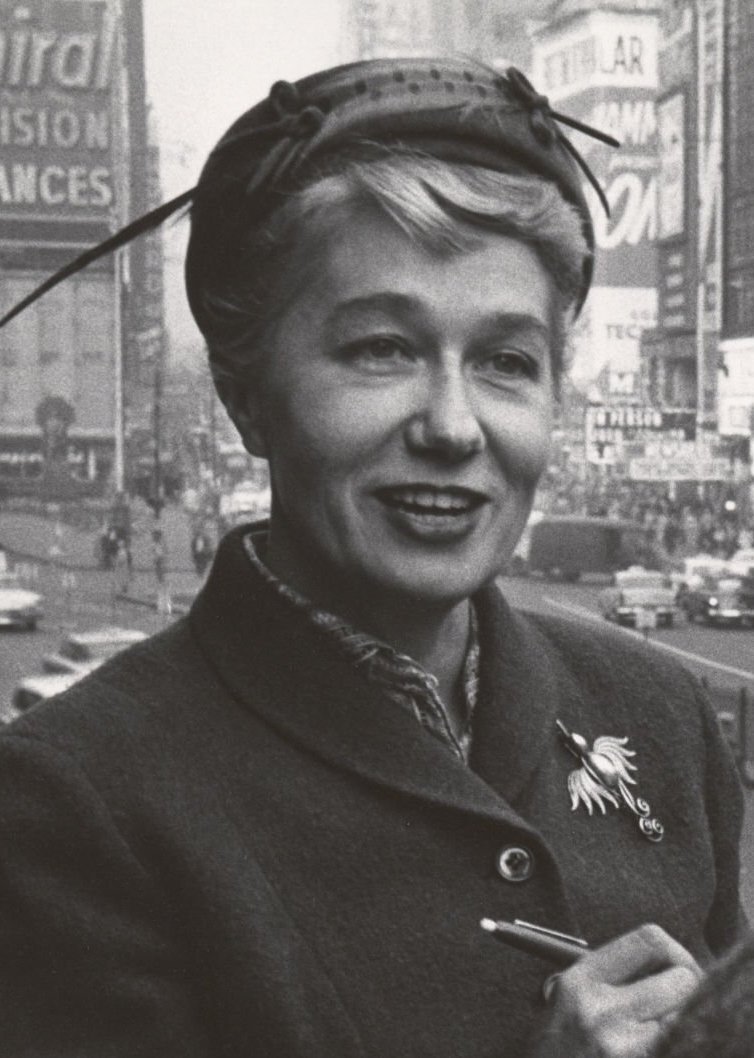
Edith Evans Asbury: Interview #2

August 9, 1988 in

Kathleen Currie, Interviewer

Edith Evans Asbury August 09, 1988 Tape 1 of 2

August 9th, 1988
Listen to audio

Edith Evans Asbury August 09, 1988 Tape 2 of 2

August 9th, 1988
Listen to audio

Edith Evans Asbury August 09, 1988 Tape 1 of 2

August 9th, 1988
Listen to audio

Edith Evans Asbury August 09, 1988 Tape 2 of 2

August 9th, 1988
Listen to audio

Edith Evans Asbury August 09, 1988 Tape 1 of 1

August 9th, 1988
Listen to audio
Page 6

Interview # 3, Part 1

[Begin Tape 13_01]

Currie: We left off basically, when you got your job at the Knoxville News Sentinel in 1933 and

you beat out Jo Ruth.

Asbury: Right.

Currie: When you got that, you went in and you did a try out, you say?

Asbury: I don't recall. I think I worked there for a week, and I think she worked there for a week

at different times, and that I was hired, but I'm not really sure. I just know we were both

candidates for the job, and then she was the candidate of Zollie Howard, the city editor, who also

ran a poetry column to which she contributed. He wrote poetry, and she wrote poetry.

I was a candidate of Benton Stong, the managing editor. The job was to assistant to Katherine

Hooper, the women's editor. Now, whether she made the choice or Zollie, or Ben, I don't know. I

don't think it was a matter of Ben wanting me and going through a pro forma thing because he

was not that type of person. He was a very fair person.

Anyway, I got the job, and I was assistant to Katherine, who was a wonderful, wonderful person.

She had never been married. She had a problem alcoholic father who was a chore to the family

and a long-suffering, sweet mother. She had a very vivacious redheaded younger sister named

Anna, who was as unlike her as day and night. I get so mad when they talk about women bosses

being bitchy. I could have never had a better boss then Faulkner, nor could I have ever had a

better boss than Katherine. They were both just marvelous, and I became good friends with both

of them.

Currie: How was Katherine as a person? Tell me a little bit more about Katherine.

Asbury: Katherine as a person was efficient and sweet and gentle and kind. She was supporting

her family and responsible.

Later on, when the war came along, she joined the WAAC [Women’s Army Auxiliary Corp]. She

was made an officer. She was given the job of ferrying new recruits to their posts, and then after

the war, she was promoted. I think she got to be a major or a colonel, and she was stationed in

Germany at Oberammergau, and I visited her there in Oberammergau. Her mother was there

with her. Before all this happened, she'd never been married. I don't think she ran around much

with men. She didn't have time. She was busy with this job and busy taking care of her family

and her mother.

But this man came to town who was just too good to be true in every direction. He was sweet. He

was handsome. He was rich. He and Katherine started going together and got married and

everybody thought, “God, how wonderful this is for Katherine.” Everybody admired her because

she was a most admirable person.

The wedding was the day after the World's Fair opened in ‘38 in New York. I was then on the

[New York] Post and everybody was doing something to cover this. I don't know what my

assignment was, but I was in the parade that went down Manhattan and I remember I was

walking and Kingsbury Smith came along in a big red car and I said, “My God, how did you rate

that?” The man sitting next to him said, “Well, get in.” So I hopped in, and I went the rest of the

way. Turns out this was William Randolph Hearst Jr. [ Laughter] I don't remember the rest of

how I covered the parade, but I know it was a hot day, and I was absolutely exhausted.

At the end of my working day, I went to Knoxville to go to Katherine's funeral. I mean,

Katherine's wedding.

Currie: Freudian slip?

Asbury: Katherine's wedding. It was just a storybook romance in every way, and everybody was

so happy for Katherine. They had this cute little house, and oh she was so happy. His mother was

so delighted they were married. She came down there and she made such a pet of Katherine and

she was so glad.

Thanksgiving B.F. called me up and he said, “A terrible thing has happened.” He said

“Katherine's husband shot himself and they suspect Katherine. They're questioning Katherine.”

Poor Katherine. She was so madly in love with him and so shattered, but to also be questioned.

What happened was that he collected guns, and evidently he was an alcoholic, which nobody

knew. There was Thanksgiving dinner and before, I guess, they went to somebody else's house.

Before they left, she said, “Please don't get drunk.”

Evidently, they went there and he ate and drank a lot and did get drunk. When they got home, he

had a crying jag and said he was so sorry. She said, “Well, you know, forget about it.”

She went in to get undressed for bed and heard this shot and went out, and there he was.

B.F. said it was a combination of the drinking and sitting in front of a hot fireplace. It made him

really drunk, and he fell asleep or something or other. When he woke up, he was so remorseful

that he killed himself, which was just terrible -- just such a horrible thing. Poor Katherine. So this

happened in ‘38.

Currie: This is after you left?

Asbury: Yes, after I left. I was on the [New York] Post.

To finish Katherine’s story, she came back and she was in. Where's the Alamo?

Currie: San Antonio.

Asbury: San Antonio. She was stationed there and retired there.

She got married again to a man who lived there, and he was a namby-pamby something or other.

He just wasn't in her class at all, but I guess she was retiring and wanted a home and so forth. By

now, her mother had died, and Anna was busy with her own family. McLendon, his name was.

So I got a letter from her – and at that time, I was going to New Mexico to visit Georgia

O'Keeffe every summer. When she said, “I settled down in San Antonio. The next time you come

to see Georgia, stop by and see me.”

Then she said, “I had a scare. They found cancer cells someplace.” She said, “They say they've

gotten them all, but, they never do.” This is what she said in her letter. So I thought, “Oh my

God, the next time I go out there, I've got to go see Katherine.” I was going on the way to

Georgia's, and for some reason or other, I changed my mind and decided to stop there on the way

back. She died before I got there. I went on, and I met her husband and it was so sad. The poor

girl, she had worked so hard and had started out with just absolutely nothing.

She had taken up collecting silver. Wait, I did visit them there once. I did visit them there once,

because, that's when I met him and I saw this lovely collection of silver that she'd collected in

Germany. She was so proud of this wonderful silver collection, and of course, he got it.

Currie: So she was your boss. Was she the person you would say was your mentor at the

Knoxville News Sentinel?

Asbury: No, no, I didn't have a mentor. She wasn't a role model. I didn't want to be a woman's

editor. As a person, I would love to have been like her. She was a wonderful person, but I could

never be like her, because she was very patient, much more gentle than I would ever be. No, she

was not a mentor, but I admired her. I loved her. I valued her.

Currie: What did she tell you?

Asbury: I don't think I ever had anybody in my life that I said, “I want to grow up and be like

her.” I never wanted that. I wanted to grow up and be like me. And I wasn't sure what me was,

but whatever it was, that's what I wanted to be. My ideas of what me was changed every couple

of years. When I went into the business, I wanted to write poetry. I wanted to write fiction. I

wanted to do this, that and the other.

I had no time for that, and then when I got in the women's department, I wanted to be a real

reporter out in the newsroom. I did some stories out in the newsroom at the [Cincinnati] Times-

Star, but I never got to that. And of course, I very shortly I was at the [Knoxville] News Sentinel,

so I wanted to be out in the newsroom and writing news stories and Katharine understood that,

and she helped me.

Currie: How did she help you?

Asbury: She helped me by letting me take time off from her to cover that kind of stuff, to show

them that I could, and by giving me suggestions. When I did a story for her, she said, “You know,

the city desk might like that? I'll ask them.” She was very helpful and eventually, with her help

and by showing I could, I was doing more and more for the city desk. Then finally, I got on the

city desk. She hired someone else to do what I had been doing.

Currie: What had you been doing?

Asbury: The things that were dumped in those days on the women’s department.

Today, the women's departments are thriving, interesting places in which very good stories

originate and they cover a wild feed of things.

In those days, the woman's department covered food, fashion, children ,and women's clubs.

That's all. If it was a thing of vital interest to women as a political issue, that would be covered

by the city desk.

Also there were little chores such as the syndicate pages would come in with the printed

women's columns. Mrs. Ferguson was a woman's columnist, with recipes and food stories and

you would cut those up and paste them and clip them and write heads to be set in type.

Then there were these terrible special editions. In those days, there was no union and so when a

special edition came along – and, of course, they sold extra advertising -- then you had to have

copy—more stories to wrap around these things. So you had the spring fashion and the summer

fashion, and the fall school thing, and we had to have extra material to wrap around those ads.

Currie: And that was in addition to what----.

Asbury: In addition to your regular work, which meant you had to work late and Saturdays and

Sundays. We had a Sunday edition and it was a lot of extra work. I just hated it.

Currie: And you didn't get paid any more?

Asbury: No more. Not $0.01 more. The advertising revenue would increase, but we didn't get

more, not $0.01 more. The theory then was you couldn't possibly pay a reporter overtime,

because when a reporter gets a story, he must stick to it till it's through and if it doesn't get

through until 9:00 that night or if he's on an election story and you don't get the final returns until

6:00 the next morning, he has to stick with it till the very end. Of course, the Guild said, “If the

story's important enough for him to stick with it till that end, it’s important enough for him to get

extra pay for sticking with it.” Even after the NRA [Fair Labor Standards Act – FLSA] law… *

Currie: The NLRB [National Labor Relations Board]?

Asbury: Not the NLRB. When there was the NRA came along, I think it was, Johnson said,

“Everybody can only work 40 hours on regular time. If he works more than 40 hours and five

days, he must be paid overtime.”*** It was a national law.

The newspaper publisher said, “Oh well, we can't do that. Our reporters’ hours can't be organized

like that. We just couldn't get out a newspaper if reporters worked that way.” The NRA says,

“You’ve got to find a way.” So they found a way. Of course they found a way.

Currie: So then you got overtime?

Asbury: Sure. Then you got overtime. If you worked extra hours it was overtime, and double

time for working on a holiday or your day off. What other business had to have, you had to have.

Currie: Do you remember what you were paid at the end?

Asbury: I went back again at $15 a week, only this time I didn't get the unannounced quarterly

increases. I got no increases unless I went in and raised hell, and then it was very small. I think I

got up to $18, which is one of the reasons I left. By that time, I'm all alone maintaining my own

apartment and supporting myself.

Currie: You had split with your husband?

Asbury: Yes.

Currie: During the time you worked there?

Asbury: During the time I worked there.

They considered being a reporter was such fun, you didn't have to pay much for it. You're

supposed to take it out in having fun, and I'm sure I got a lot less because I was a female. The

idea back then was that as a female working was a luxury that you chose to indulge yourself in,

and you didn't really need the money. Your husband's supporting you, so they don't have to give

it to you. That was the attitude everywhere.

Currie: Did you know how much money the men were making?

Asbury: No, no. But I'm sure they were making a lot more. Well, not a lot more. This was the

depression. Nobody was making much. Things were a lot cheaper, too. I think I paid $25 a

month's rent for an apartment.

Currie: So you had your own apartment in Knoxville?

Asbury: All the time I was in Knoxville, I was in an apartment. I lived in an apartment with Joe,

and then we moved to a small one. Then we moved to a larger one. When we were divorced, he

was supposed to give me alimony, which he never gave me, and I couldn't afford to stay in that

apartment, which was a very nice apartment. I think I sublet that furnished and moved to a

cheaper place. It was an attic apartment, but it was very nice. It had a terrace and a porch in the

back.

When I first went to Knoxville, friends of mine -- a professor who taught at the university, and

his wife, who was a daughter of a dormitory matron at Western [College] -- were living in that

apartment. It was a very nice apartment. It was on the top floor. I didn't have a lot of wild parties,

but any time you had company and they made noise, the woman underneath kept complaining

about the noise. One night I had a party and B.F. was there and I don't know whether it was he or

somebody else, but they were feeling pixie and kicked a bottle step by step by step, all the way

down all the steps. Anyway, because this woman was a damn nuisance, you were afraid to walk

across the floor because you’d get a complaint. It got to be very, very uncomfortable. So I moved

out of there to another apartment, which was very nice.

Then when I was contemplating leaving and moving to New York, I worked on that for a couple

of years, I laid plans so that if I got up there on my vacation and got a job, it would be easy to

make the switch. I remember Jo Ruth and I sitting in the middle of the floor, going through all

these papers deciding what to throw away so that I could move out of there to a little hotel across

the street from the [Knoxville] News Sentinel. I had one room and a little ----------

Currie: A kitchenette?

Asbury: No, no, just one room and a little counter-type-hole-in-the-wall place to eat on the first

floor. It was it was like a coffee shop, only quite small across the way. I had a piano, which I left

with a woman whose daughter was taking lessons, and the rest of the furniture, I guess I sold. I

had some lovely furniture that I'd bought in the…..

Currie: You were streamlining your life.

Asbury: I was poised for flight like a bird.

Currie: Well, before we go to your flight to New York, let's talk a little more about the

[Knoxville] News Sentinel.

Asbury: We had a wonderful time at the [Knoxville] News Sentinel. Benton Stong was only 28

years old. He was very bright. Everybody just loved him, and he was the editor. It was a Scripps

Howard paper. He was the youngest editor in the Scripps Howard chain and just a delightful

person. Delightful.

There’d been a campaign for years in the Senate to develop Muscle Shoals, the power in Muscle

Shoals and there was a campaign for publicly owned power. The New Deal….

I guess Roosevelt was elected while I was there, because I remember talking to somebody down

there about the candidate, the presidential race, and he’s saying, “Well, nobody knows anything

about this guy, Roosevelt.”

There was a town character named Dr. John Randolph Neil, who was unkempt and raggedy-

haired and a fanatic on publicly owned power. He was a Harvard graduate and a brilliant man,

and he ran a night law school there, upstairs in one of the buildings. He went around making

speeches about how power should be publicly owned, and he had a brother who was the admiral

of the Presidio in California, who was ashamed of his appearance.

So Roosevelt came in and the TVA [Tennessee Valley Authority] started. I went there in ‘33.

This is a bad part of the Depression. When I got into the news department, the stories I was

writing were about people starving on relief, welfare red tape, the Red Cross distribution of

powdered yeast to families to cope with Pellagra, and a little grocery store on the corner that sold

nothing but flour and potatoes. That's all they could sell, because that's all the people could

afford to buy. The main street was called Gay Street. That was the name of the main street of

Knoxville. I wonder how they’d deal with that, now.

The stores all up and down were closed and empty. The place was just devastated. Then when

the New Deal came, when Roosevelt was elected, and when the TVA started and these big plans

were announced for development of public power in the Tennessee Valley, these empty buildings

began to fill up with TVA offices. These empty stores began to open. You could just see the city

come back to life, again.

There was a lot of controversy, and a lot of people against this. In those days, Howard was a

liberal and we were running editorials in favor of the New Deal and Roosevelt and TVA, and this

was in a rock-ribbed East Tennessee Republican section of the state. It was terribly interesting,

and we were all so happy to be on this paper that was campaigning for the New Deal and the

TVA and running these liberal editorials. We were like one big happy family and our whole lives

were each other. We were together in the evening, and we were together weekends, and we were

together in there, and we were all just having a ball, earning a living, having all this fun, and

such an esprit de corps, and all in love with our boss. It was just a heavenly place to be,.

There was only one sour apple in that barrel, and we didn't find out until later after the Guild

started, and he ratted on us. He was a sour apple. At that time, he wasn't a factor. He was just

somebody who was there, but the rest of us, we were young and enthusiastic, and we had a

wonderful time. Katherine helped me get into the news section very quickly, and I was covering

politics and city hall and of course, relief efforts.

The coverage of relief led into politics because politicians were mixed up in it. The state director

of the relief organization that was called TERA, Tennessee Emergency Relief Administration

and was being discussed as a candidate for governor. While I was covering him, I was always

pinning him down and asking, “Is it true you're going to run for governor?” I wrote a story that if

I picked it up today, I would cry, again and it got on page one. It was just unbelievable.

There was this large, poor family and one of them died. I forget which. While they were trying to

straighten that out and getting nowhere with the bureaucracy, the other one died, and gradually,

one by one, they all died. I'm writing this final story about how even now, when you're burying

the last one, the rain was pouring and they stumbled with the coffin. I think the next day the

check arrived that had been delayed all this time.

Currie: What did they die of?

Asbury: Starvation! People were starving or freezing. They had no money, and they had no

resources. They had no medicine. They had nothing. The check was there to be given to them,

but it was delayed by the bureaucracy, and when it finally got there, they were all dead, one by

one. God. This is what went on. I was pretty goddamn mad about it. I wrote a lot of stories like

this. I wrote many stories like this that when the guy did decide to run for governor, he wanted

me to come and be his PR person. I said, “No thanks.”

Currie: Why did you say, “No thanks?”

Asbury: Well, he obviously wanted to buy me off with a nice fat job and salary and cancel my

chasing of stories like this. It reflected on his administration as ERA, as a relief administrator.

His name was Bergen Dossett. It was wonderful to be able to go out and get those stories and put

a spotlight on these negligent bastards and be encouraged to do it and then see it in the paper the

next morning. It was a big thrill.

Currie: Let's talk about the transition from women's coverage to the city desk. How did you

know how to go about getting a hard news story?

Asbury: In the women's department you had something of the same thing. The basics of

covering a story are the same in any story, in any field, in any area. For instance, when I was on

the [New York] Times and I was sent out to cover the wedding of Harry Truman's daughter and

Clifton Daniels, I had to find out what kind of flowers would be used in the church, what she was

going to wear, and who the attendants were. The same thing that I had done on previous wedding

stories. I forgot to tell you that when I was working for Katherine, I wrote wedding stories.

Another thing I wrote while I was in working for Katharine were obituaries.

They dump on the woman's department in addition to women's things, those things that nobody

else wants to bother with. Obituaries are difficult. You don't dare misspell a single word, and you

have to get all the details. So every morning, I would call all the undertakers and find out who

had died and get their names, where they’d died, their addresses, their relatives, and the funeral

details and so forth.

The same principle applied when I was on the New York Times and covering Al Smith's funeral. I

had to find out who the pallbearers were, how the church was decorated, and who was going to

preach. In fact, not being Catholic, I went over to the church a day ahead of time and went

around with this Monsignor Sheehan, who was Feldman's press agent, to find out what you call

this and what you call this and so forth. I was with the Associated Press then, not the [New York]

Times.

When I left, he said, “Would you like to have a medal?” And I said, “Well, yes.” I didn't know it

was a little religious coin of some type, and then he said, “Would you like to have me bless it?” I

said, “Well, if it makes you feel any better.” So he did a double take and gave it to me. I went

back to the AP office waving it, and I said, “I have a medal blessed by Monsignor Sheehan.”

Nobody even looked up from the typewriter. Well, maybe a couple did. There were some

Catholics there.

The same principles of journalism applied, and you have to be diligent about getting all the facts.

You have to verify them and be sure they're accurate. You have to decide what you're going to

lead with. Then you have to assemble everything to follow that. You have to keep it brief to fit

the space, which means you have to make a choice of what to leave in and leave out. Those

principles apply to any story you do. I don't care what it is. That is the main thing, and then you

write it as well as you can. If it's a news story, you don't have room for fancy writing, but you

write as well as you can within those constraints. Also, you have to be sure that you're fair and

not slanting it, but that's part of the reason that you're so diligent about getting all the facts from

both sides and all sources. Then, present it in an orderly and fair and as interesting as possible

way within the constraints of space. So the same principles apply to writing the obituaries as

applied to writing about the administration of the welfare program. It's more complicated, but the

basics are there.

Currie: Did anyone tell you this or did you learn it on the job?

Asbury: Well, Katherine, I suppose, told me. It was a combination. I suppose Mrs. Faulkner told

me. Yes, she probably did. Nobody ever sat down and said, “All right, now, this morning we are

having a journalism lesson.” And I never had a journalism class.

In New York, when I was working on The World-Telegram, this wonderful English teacher

whose husband was teaching at Hunter [College] said, “They're looking for somebody to teach a

journalism class in the evening and I think you'd be good at it.” I said, “Well, I wouldn't know

how to teach it. I never had a journalism class.” “Well,” she said, “they give you a lesson plan

and you just follow that and you know how to do it, having done it all these years.” I thought,

“That would be fun. I never taught journalism and it might be fun,” and hundreds of very

respectable --- It was a very high-class school and there was a little money involved, not much.

So I said, okay. This is in summer. I went in and talked to the guy and he hired me.

About two weeks before this thing started, I called him up and I said, “Where's my lesson plan?”

He said, “What lesson plan?” I said, “Well, I was told I would get a lesson plan for teaching this

course.” “No,” he said, “you just do it any way you want to.” I hung up the receiver, and I

thought, “My God. I don't know how they teach journalism courses.”

So I went over to Fourth Avenue, which at that time had a lot of secondhand bookstores. It was a

happy hunting ground of secondhand bookstores. I dashed in and out of those stores all the way

up for a couple of blocks, and in each one, I bought a journalism textbook. I took them home and

read them and each was as lousy as the other. I didn't know how I was supposed to teach it, but I

knew this was not the way to teach it.

There were a lot of misinformation and a lot of pompous pomposity. They were terrible. One had

been written by a guy that I had known in Tennessee whose only job ever was on the [Knoxville]

News Sentinel when I was there. The city room that he's describing as a typical city room, was

the city room here at the [Knoxville] News Sentinel, which is just one city room in a town of a

population of 130,000. It was not like all city rooms. His job now is doing PR at the University

of Tennessee. So from this base of experience, utterly limited, he'd written a journalism textbook.

Most of these books were terrible, but in most of these books, there was one good chapter. One

guy had a good chapter on a lead. Another guy had a good chapter on features. Another guy had

a chapter defining news, and the one really good textbook among them all was a very thin one

for high school, written by a woman. That was a good one. So from these chapters and from her

basic one, I did an outline, and that's how I taught. I was feeling my way as I went along. As I

was grading papers, I saw where they needed help and where I hadn't been giving them what

they needed. That's how I taught it. I want to tell you, I was terrified.

These were all working people, and only two or three of them had a genuine intention to go on in

journalism. They were just sort of taking it for the fun of it. There was one guy in there, a really

rough, tough-looking guy who was a cab driver, who told me that he was a real writer already

and showed me a stack of one-paragraph letters to the editor that had been printed in the Daily

News signed by him to prove it. There were a couple of young girls. I think they were already

working on Time magazine in clerical jobs, and they had a serious interest. There was a middle-

aged woman in there.

I figured since they're all working, they didn’t have time or energy to do homework, so I didn't

give them homework. I mostly brought people--friends of mine in to be interviewed, and then I

would take notes on what questions they asked and criticize that. Then I graded the papers and

criticized on how they assembled their facts and things like that.

The middle-aged woman came up to me, and she said, “Would it be all right if, instead of writing

up the interview of the person you brought to the class, I did a story about an interview with

Mayor Impellitteri?” And I said, “You did an interview with him.” She said, “Yeah.” I said,

“Well, sure, sure. How did you happen to interview Mayor Impellitteri?”

She was a teacher of deaf children, the school for the deaf and she had taken them in a block as

guests of the circus to see the circus. They're all sitting there. She looks down in a front-row box

and she sees Mayor Impellitteri. She goes down there and she says, “Pardon me, I'm a student of

journalism at Hunter College. Could I interview you?” And he says, “Sure.” I know him very

well. I liked him. “Sure,” he said, “of course, go ahead.” I have to say I was delighted with her

enterprise. I was just so delighted I gave her an A+ without reading her paper. I just thought that

was so wonderful. I considered it a compliment that the things I've been telling them about

enterprise had emboldened her to do this.

Currie: That's pretty gutsy.

Asbury: It sure was.

Currie: Particularly as a student

Asbury: And she's a middle-aged….. I mean, she ran the risk of being humiliated in front of the

other people in the box. She was so dedicated to getting this interview that she just threw that to

the winds. And how did we get into this?

Currie: Talking about the Knoxville News Sentinel and then you making the transition to the city

desk and how you learned how to do these things?

Asbury: How I learned how to do these things. Well, I learned by doing largely, but under

direction and criticism and friendly suggestion as a need arose, I guess Mrs. Faulkner must have

really told me the basics.

Currie: When you went to the city desk or the city room?

Asbury: City desk. We were all in one room. This was a small paper. This was a small city desk

on the first floor where the business and circulation offices and then you walk up ----

[Tape Ends]

* On June 25, 1938 in the midst of the Great Depression, President Franklin
Roosevelt signed the Fair Labor Standards Act (FLSA) , a landmark law that
mandated a national minimum age, ended child labor, and set out regulations for
overtime pay.

*** President Lyndon Johnson pushed for extending the FLSA’s protections, including
overtime pay, to more workers, aiming to increase job opportunities and improve
working conditions.

Page 7

Interview # 3, Part 2

[Tape 13_02 begins]

Currie: You were saying your desk was right at the head of the stairs.

Asbury: My desk was right at the head of the stairs. I was here, and then Katherine's was next to

mine, close to the window. Then, in back of me in the corner, was the sports department, which

consisted of a sports editor and a couple of assistants. Then you walked through the room where

the reporters desks were, and there was the city desk -- a round desk with the copy readers

around it. The managing editor sat there on the rim, as it was called. It was circular.

Most copy desks are circular because they all have to communicate with each other. On one side

was the managing editor, on the other side was the city editor, and then the copy readers were

around the circle. The suburban editor was there. The telegraph editor, Miss Lucy Templeton -- a

lady -- was there, which would now be called national editor and assistants around here.

Ben Stong, the editor, was in the corner office, and his secretary had a desk outside -- Ms.

Penland. There were file cabinets in back of her. Surely that wasn't the morgue. The reporters

were in between.

Anyhow, I was right there at the head of the stairs, and every nut in town always heads for a

newspaper office. We had no such thing as a receptionist or anyone to screen them. Anybody

who wanted to could come in the door and up those stairs, and be in the sitting room -- and I'm

right there to get the flak. If I could, I'd say, “You have to go over there and talk to the city desk,”

but sometimes they wouldn't want to wait, they’d tell you all about it. However, sometimes

you’d get a good story.

One time, I was sitting there and there was nobody else around. I don't know why I was there,

but I was working late on something or other. It was an afternoon paper, so most people ducked

out in the afternoon if they didn't have anything to do. Then, of course, they were out covering

stories and so forth.

This guy came up -- his hands were just orange with nicotine, and they were shaking. He needed

a shave, his collar was wrinkled, and he had a rumpled tweed suit on. There was some sort of a

furtive look about him. Maybe he was having D.T.’s -- I don't know. So he came up, and he said

to me, “Is Johnny Mutu in?” And I said, “No, he's out.” And he said, “Well, do you know how I

can get in touch with him?” Well, I wasn't going to put poor Johnny Mutu at the mercy of a guy

looking like this. I said, “No, I'm sorry, I don't. Do you want to leave a message?” He said, “Yes.

Tell him Sherwood Anderson was here.” [Laughter] Well, it was too late to say, “Mr. Anderson,

wait a minute. I'll see if I can find him,” or something or other.

Currie: So did you?

Asbury: No, but I said, “Well, can he get in touch with you?” I don't remember the rest of it. I

just remember the shock of his saying…..

Currie: And you knew who Sherwood Anderson was?

Asbury: Sure, Of course. Of course. He was one of the best known writers in the country. By

this time, Ben had gone. I’ll tell you all about that. That was something.

We had a real mean, nasty editor. I just hated him. Everybody hated him and he hated everybody.

He just killed the city room. He came out on Christmas Day. Of course, you work Christmas Day

if you were told to. I guess maybe you got two holidays a year and you could pick them and

work… I don't know.

Anyway, he came out on Christmas Day and put on the city desk -- big hearted – a box of cigars

for the men and a two-pound box of chocolates for the women.

Well, of course, the men immediately ate all the chocolates before I could even get up to the

desk. I got up to the desk, and the chocolates were all gone and I said, “Well, my God. Merry

Christmas, everybody. This is ridiculous -- this small box of chocolates here for women and all

you men eating them up.” So one of these men said, “Well, have a cigar. There are plenty of

them left.” I said, “All right, I will.”

I picked up a cigar and went back to my desk. I had never, of course, ever smoked a cigar. They

were all watching me. I was brazening it out. Maybe this was a day before Christmas? Anyway,

I was brazening it out, and I lit it up and took a puff and nearly dropped dead. Got sick as a dog. I

just took a puff and very quietly laid it down on my ashtray and went on typing. While I'm doing

this, this woman walks up the steps and sits down, and she has a WCTU notice for me.

Currie: Which is?

Asbury: The Women's Christian Temperance Union, which was very, very powerful there. The

place was dry. There was no legal liquor. So I took it, and she gave me the information. I saw her

all of a sudden go [sniffs], and I realized that a smoking cigar was lying in that ashtray. They

were as violently against tobacco as they were against liquor. I started to explain -- she was a

very nice woman -- I started to explain and I thought, “What's the use?” I could never explain.

She's going to go out of here and say, “I talked to that terrible newspaper woman, and she

smokes cigars.” So I pretended it wasn't there and finished taking the notice. She didn't say

anything and went out, but I'm sure she said plenty when she got out.

Currie: Did newspaper women have a reputation for being tough?

Asbury: Well, I don't know. Who would tell me?

Currie: So nobody ever told you that?

Asbury: Newspaper people, male and female, have different reputations in different people's

minds -- depending on whether the people know any or not.

Currie: In terms of in Knoxville, where did reporters fit into the social scene?

Asbury: I would think most of them were native. People didn't travel around then the way they

do now. There wasn't the urge, opportunity, or money. Even if you went away to college, you

came back and settled down in your hometown, and at that time in the Depression, the jobs were

very few and far between. You probably had to stay home to get one. They had their family and

their friends. Most of them were married, and they had come from there and had their parents,

cousins, aunts, uncles and so forth. Also, we all associated with each other -- all of us.

Currie: So did you have parties?

Asbury: We had parties, sure. We visited around each other's houses mostly, I guess.

Currie: So if you had time off you'd mostly socialize with other reporters?

Asbury: Well, no. I had all these friends from the university before I went there and these local

people that I had met. I had a rich, full social life, but a lot of it was with the other reporters

because we all enjoy each other's company so much.

Currie: When you went to the city desk, who was your editor there?

Asbury: Well, they had Zollie Howard, the guy who had sponsored Jo Ruth and Joe Levitt, who

was extremely efficient. They both had ulcers. I mean, there was a lot of ulcers in the newspaper

business because there was constant stress. I guess the kind of people who were attracted to the

business must have been nervous Nellies -- I don't know.

But anyway, they both had ulcers. They were both very nervous and they sort of alternated back

and forth between the jobs of Sunday editor and city editor. When one would be in one job so

long that his ulcers kicked up, he would switch to the other one -- as if that's going to be easier. I

guess maybe Sunday editor was a little bit easier, but neither one was easy. It was just that this

one had gotten such a hassle that he thought, “If I go back to being Sunday editor, maybe my

ulcer will calm down.” So they were back and forth, these two, and they were both very good,

but they're very different. Joe Levitt was more efficient, less emotional, and really taught me a lot

because he was very severe.

Currie: He was still there even when you were in the city desk?

Asbury: They handled our copy, too.

Currie: I see. So they just left you at the same desk?

Asbury: No, I moved my desk, but all of the copy went through this copy desk. So I'm sitting

way back here at the other end of the room.

Well, now, wait a minute. Katherine handled the woman's department copy, so maybe I wasn't all

the way back there. Anyway, I was far enough away that Joe Levitt called out in a loud voice,

“Ms. Evans, how do you spell separate?” Of course, everybody stops and looks up, and I jump

up and run over to the desk, answering him so we can get this back down to a conversational

tone. Believe you me, I never again misspelled separate. That's the way he was.

He was a very severe taskmaster, very intolerant of sloppy work, misspelling or anything like

that. Boy, you learned and I used the same technique when I was on the World Telegram when I

was assistant women's editor. I had eight prima donnas that I had to handle. It was a murderous

job.

This girl -- the woman that did my hair -- told me about her, said she was a home economist

looking for a job, and at the time we were looking for a food writer. Her name was Mary Apple -

- sort of a fussbudgety girl from the Middle West, very concerned with her clothing, a very

devout Catholic and home economist. She had been working for a pollster -- what was his name?

-- in an executive job because she was extremely efficient and methodical.

I said, “We need a food writer. Can you write?” She said, “Well, I've never written, but I'll try to

learn.” There isn’t a lot of work to do writing food, then. It was a plus to get a food writer who

was a home economist and had sense about recipes and things like that because you run a recipe

and you have one little thing wrong, and you get 10,000 protests from people who tried it and

said, “I put 12 eggs in there, but the thing blew up and besides, the 12 eggs cost X dollars. What

kind of a food page have you got?”

So I hired her. She could not write. All she had ever written were business letters -- years of

dictated them to her secretary. So she labored over it, and I labored over it, and she read books on

writing, and I criticized her copy. She was a very diligent student, and she was doing pretty well,

but one day, all across the room when I called out, “Mary, how do you spell separate?” She did

the same thing I did -- rushed over [Laughter] to get this discussion down to a conversation that

couldn't be heard all over the city room. We were in a corner of the city room, too - the women's

department. She never forgave me. You see, she was an older woman, and she was really

affronted. She thought this was unnecessary, whereas I was very grateful. I mean, at the time I

was horrified, but I was grateful to Joe Levitt because from him I learned a lot, a really lot.

That's why I was on the city desk and working. He was very good. I felt really elated if he ever

praised me for anything, which was very rare. He was very stern. Everybody thought he was a

real mean bastard, but I knew he wasn't because when I divorced my husband, I didn't want any

publicity about it. It was a private matter that I didn't want aired. However, I thought, “If this

comes out in the other paper -- Joe was very prominent -- if this comes out in the other paper,

my paper might be mad and say, ‘Why didn't you tell us about this?’” I struggled over it and

struggled over it. I didn't know what to do, and finally, I went to Joe Levitt. I said, “Joe, I don't

want any publicity about this, but I think I have to tell you -- for fear it would come out in the

other paper -- that I'm getting a divorce from my husband.” He didn't bat an eye. He just said,

“Well, we really should tell Cunningham.” Cunningham was the one who covered the courts. He

said, “Because if it comes out, he's the one that'll be blamed for not….” And he said, “You can

do what you like, but I think we should….,” and I agreed.

He called Bob Cunningham over and he said, “Ms. Evans just told me that she's gotten a divorce,

and I think we ought to have a line or two about it.” That's what they did, a line or two about it.

He was very fair and compassionate in his discussing this with me in the pinch. There were rare

occasions like that. He was marvelous. Oh, he was good.

Well, there have been several columns in The Washington Post about Joe Levitt, which B.F has

sent me. You could ask him about them -- written by somebody in Washington who used to work

for him. He was fabulous. Fabulous.

Currie: What else did you learn from Joe Levitt?

Asbury: Well, I learned the fundamentals of the newspaper business from Joe Levitt. I can't tell

you in detail.

Currie: Did you report directly to him on your stories?

Asbury: When he was city editor, I did. And when he was not, I reported to Zollie.

Currie: Did he help you think up assignments or did you come to him with ideas?

Asbury: He gave me assignments, and if I had any, I took them there. Basically, they gave me

assignments, and then out of these assignments, other stories might follow, which I would

anticipate or suggest. Basically, city reporters are on assignment. In fact, I've been places where

they didn't like it if you gave them an idea. They thought they should have all the ideas. I've also

been places where if you gave a suggestion, they might decide it was too good for you and give it

to somebody else. I think most reporters are on assignment, unless you're covering a beat where

things come up, but I never wanted to cover a beat.

Currie: Why not?

Asbury: I wanted something new every day. Also, if you're working on a beat, you get too close

to the people you're working with, and you begin to get protective of them and begin to adopt

their point of view instead of the unbiased, objective view, you should maintain as a reporter.

Currie: Was there ever a story where you had a hard time maintaining an objective view?

Asbury: Oh, there were lots of them. Lots of them.

The Scripps Howard papers used to have on the masthead a drawing of a lighthouse with their

motto under it. What was it? Well, it was stated in a different way. What it boiled down to was

“If you give the people all the facts, the truth will emerge.”

If there was a story I was bothered about, I just had the feeling that if I gave all the facts, any

rational person would come to the same conclusion that I privately held.

Currie: Do you remember a story like that that comes to mind?

Asbury: No, not right now. But I still believe that. I could be perfectly cool and unbiased about

anything, but I can't think of anything right now.

Currie: How many other women were in the city room other than the one’s working in the

women's department?

Asbury: I don't think there was anybody else.

Currie: Was it unusual to have a woman working on a paper?

Asbury: Well, of course, all over the world it was unusual to have a woman on a paper. Even

when I came to New York, they never had more than one or two token women or women doing

so-called women’s stuff.

Currie: So how did the men treat you?

Asbury: Fine, fine. Newspaper men respect women -- unless they're in competition with you.

We were all working together, you see. Newspaper men working with newspaper women -- if

they're decent people, not bastards -- they respect ability and they respect professionalism. They

would have no use for somebody on the staff who would sashay around flipping her hips, rolling

her eyes, wearing gaudy clothes and heavy makeup. But if you're just a competent professional

and a normal person, they really always accepted me as just one of the reporters. Not one of the

boys. I was never one of the boys. I was one of the reporters.

Currie: What's it like? Tell me, what do you mean by you were never one of the boys? What

would it be like to be one of the boys?

Asbury: Well, if you tried to be like a man – drink, swear, smoke cigars and be tough. I never

tried that. Sit and play poker with them -- I never played poker with them. I sat over on the other

side of the room, and I wore feminine clothes. I didn't swear and I didn't smoke cigars, except for

that one time. [Laughter]

There are women who feel that they've got to act real hard-boiled and tough and prove they're as

good as a man by acting like a man. I never felt that way.

Currie: Did you ever date any of them?

Asbury: Of course. Of course. You date the people you associate with. It was all good clean fun.

Oh, yes. The sports editor was mad about me, and I liked him, but he didn't appeal to me. He

adopted a proprietary…... One time, I was having a party at my house, and B.F. was there. It was

on the first floor, and this guy came banging at the windows and said, “Are you having a good

time in there?” Some of the men in there and had to go out and drive him away.

One day -- I shouldn't make fun of the poor guy -- but one day, he brought a bottle of perfume

and put it on my desk and walked away. I don't remember what it was, but all perfume is

expensive. I took it out of the box and I went wham and broke it on my desk. Of course the

whole corner of the room smelled to high heaven for quite a while, and it was a constant

reminder to him because he was only a short distance away.

Currie: So that was to show your …..?

Asbury: Well, of course. Of course.

Currie: … your disdain for this character?

Asbury: Stay away. Stop trying to woo me.

Currie: Miss Lucy Templeton, you mentioned, was the Telegraph editor?

Asbury: She was the Telegraph editor, and she also wrote a nature column. Miss Lucy -- she was

much older than we were – she was an aristocrat from local aristocracy and she wrote this lovely,

beautifully written nature column, but there was something a little hard-boiled about her manner.

She worked like a man over there at the desk, handling this national copy.

Currie: So that would be like copy you get from the wire services?

Asbury: Yes. She handled national. There was a local guy, but I guess he was in charge of

stringers, maybe. You know, B.F. can tell you more about her. He knew her well and long before

I did, because B.F. was coming in there as a kind of a freelancer long before I arrived on the

scene. He knew Miss Lucy better than I did. We had lunch together, you know, and we were

there together, but we didn't hell around together. She lived out in the country someplace.

Currie: And was the editor you respected so much, Benton Strong?

Asbury: Stong. He had come from Iowa -- Keokuk, was it? -- and his brother, Phil Stong, wrote

a book called State Fair, which was made into a movie. We had a big party when it came to

Knoxville. It was a very popular movie, I think. Well, the book was popular, and then the movie

was popular. It seems to me Will Rogers was in it.

Ben had a lovely wife, Elsa. Ben as a hobby, made hooked rugs, and they had a little girl -- a

very, very bright little girl. What was her name? Of course, I knew Ben and Elsa socially. They

came to these things.

Here we had this lovely staff, all this esprit de corps, and Ben started getting drunk and

disappearing. Roy Howard could never get him on the phone. Finally, Roy Howard came down

to see what the heck was going on, and he couldn't find Ben. We didn't know at the time what

was happening, but I'm sure now what was happening is it’s when Scripps Howard was swinging

away from its liberalism and New Dealism and becoming rightist, probably making suggestions

or maybe giving orders about coverage and editorials that were going against Ben's grain, and he

was bottling it up in himself.

Anyhow, he was just drunk all the time, and they replaced him. At his own expense, Scripps

Howard sent him out to Iowa to a place where they’d dry him out, and they brought in this

replacement. I don't know that I should even mention his name because I hated him so. We all

hated him so.

Currie: But this isn't coming out until when?

Asbury: 15 years.

Currie: After my death. Right?

Asbury: Right.

[Tape ends]

Page 8

Interview # 4, Part 1

[Tape 15_01 begins]

Currie: You were just talking about Benton Stong. He left the [Knoxville] News Sentinel and

you were about to talk about what had gone on there.

Asbury: Well, he left the News Sentinel, and he was replaced by a man who was entirely

different. First, we hated to see Ben go. We were one happy family, and it was fun -- not work --

to put out the paper for him. Also, the circumstances under which he left and was sent out to that

drinking dry-out place was a very sad occasion. Nobody could have come in and filled his shoes

or taken his place in our hearts.

The man that came in was very cold, unfriendly, aloof -- everything Ben wasn't. It was as if we'd

all been sitting around drinking beer, and suddenly the foam was gone. I don't think any of us

read the editorial pages. I never did. I never read editorial pages until now, and I guess the reason

I read them now is I have more time to read the whole paper. We gradually became aware that

the Scripps Howard editorial policy was changing from enthusiastic New Deal, and without

Ben's direction, without that esprit de corps, and with this man actually beginning to not just be

negative but be hostile…….

Currie: Hostile to the reporters?

Asbury: Yes.

Currie: How did he exhibit that?

Asbury: Let me finish this sentence. Our work began to feel more like work. Before, it was pure

enjoyment. No matter how hard the physical or mental labor, or how long the hours, it was one

long, happy, fun exercise. Now, it was work, and at the same time, the printers were pointing our

attention to the fact that in New York they were forming a union to see that reporters enjoyed the

same benefits -- security, pay standards, regular increases and so forth -- that they, the printers

had been enjoying for years. Well, in a small paper like that, the printers and the reporters knew

each other. We were all on the same floor. There was just a door between us, and there was a lot

of back and forth.

Katherine laid out pages and dealt with printers. I'm not sure whether I really laid out any pages,

but I knew one of the printers pretty well. He was a handsome guy, had a lovely wife who was a

piano player that I knew socially through music circles. He may have been the foreman of the

printers.

Anyway, when they started telling us this, we just laughed at them. We didn't laugh at them, but

we turned a cool ear because, my goodness gracious, we were white-collar workers. We weren't

overall workers with oil on our hands. We began to look a little differently at the whole job, and

then some of the printers told us what they made. When we found out these overalled guys were

making three or four times what we were making -- plus getting paid for overtime, plus

guaranteed vacations -- we began to be interested, especially in the fact that this guy was doing

things that were demoralizing and that we began to want a recourse from. For instance, this

Johnny Mutu that I told you about -- who I think came from Evansville -- had a career. He was

older than some of us, and he had a career elsewhere of being a very crusading, liberal reporter

of stature. His name was known outside Knoxville before he got there.

He was covering stories connected with the construction of our first airport. The road to it, I

guess, was probably a Public Works Administration-financed thing. They were doing a lot of

building around there then, out of New Deal fund organizations of one kind or another. Also,

TVA [Tennessee Valley Authority] money and people were coming there that required more

services. He did all the stories on the construction of the airport, and then they had a maiden

flight from Knoxville to Washington to inaugurate this service. Johnny, of course, thought that he

would be on this maiden flight. He was looking forward to it, especially because he had married

a local girl, had a couple of kids, and his wife had a nervous breakdown and she was in a mental

institution in Washington. Is it St Catherine's?

Currie: Saint Elizabeth’s.

Asbury: Right. So he was looking forward to being on this maiden flight and writing the story,

and then visiting her while he was in Washington. Well, this guy, not only told him not to go but

let this seat go empty to Washington, which was a terrible blow to Johnny, and it just made the

rest of us furious. You know, it made no sense and it was heartless. He was just being arbitrary.

Why, I don't know.

So there were things like that. Anyway, we were all beginning to get fed up. East Tennessee was

such a rigidly right-wing Republican area, and there was such a communist scare around and

such a hostile attitude toward union on account of the industries around there. They didn't want

their mills or their mines unionized. So it was worth your life to show an interest in a union --

except for the printers whose union was well established 50 years before. There were very few

other unions, and certainly no further ground for a new one, especially founded by Heywood

Broun, the wildly liberal columnist.

We began to be interested in this and see the point of it, so we didn't dare write to New York for

literature from the Newspaper Guild and have it back addressed to the name of any of us at home

because the postman would tell somebody. Somebody would tell somebody and somebody, and

then we'd be in trouble, especially with this guy there.

The printers, already the lanes of communication with the union movement, obtained from New

York for us literature about the Guild. We read it, began having meetings and discussions, and

finally we decided to organize. The printers sent the information to New York, and the Guild sent

the charter -- our charter --organizing us back to the printers.

I forget who was the first president. I was the first secretary-treasurer, which means I was the one

that had to do the work, but I was by now very avid for this -- largely on account of that guy, plus

the logic of what I was reading and the comparison of the printers’ salaries with ours.

We were subjected to a lot of abuse, like the overtime work for days and days on elections, and

what had been done to Johnny -- with no grievance procedure possible, no raises and no

friendship or anything from the editor. Nothing but hostility. So we unveiled ourselves and

demanded a contract. He just blew his stack. We went in and said, “We're a union now, and we

want a contract.”

Currie: So you just made an appointment with him and went in?

Asbury: I don't remember the details. I just know we went in and told him, and he was furious.

Currie: What did he say?

Asbury: I don't remember the details. I can only tell you that we confronted him, and he was

furious.

While this is going on, I had my own personal decisions to make. I went in to him before we told

him about the union -- and this is one of the reasons that I became an active perpetrator of the

organization -- and asked for a raise. I hadn't had a raise for a long time, and I was making

maybe $18 a week. I went in and asked for a raise, and he said, “No.” I said, “Well, why not? I'm

entitled to one. I'm doing a good job and if you don't believe that, look at page one every day.” I

hadn't had one for a long time. He said, “Well, if you don't like it here, you can always go

someplace else.”

I went out of there so furious because of the other people who could not go someplace else. It

was true. I was footloose and fancy-free, and I could go someplace else. But there were men

there with children and houses and mortgages -- and Johnny, with his sick wife -- that were

chained there. And he could, and I'm sure he would, say the same thing to anyone else. I could

hear him say, “You go someplace else.” Well, that really did it for me. Number one, I plunged

into the union. And number two, I decided I was leaving.

But I didn't feel I could leave after I started this ball rolling until:

A) it was in the first step of starting negotiations for a contract, and

B) there was someone else to take over my job.

So I looked around the room, and there was this, this Dresden-china, pink-cheeked, white-

skinned, lovely-looking girl. She was so beautiful and slender. She had curly brown hair, very

gentle and very sweet. You would never think of her as a Guild secretary-treasurer.

However, I knew she was very conscientious and would accept a responsibility like this. Of

course, she was a friend of mine. We were all friends. Her name is Berniece.

I said, “Berniece, you know, I'm going to go on vacation in the fall, and if I can get a job in New

York, I'm not coming back. I can't stand this place anymore. But if I don't, the Guild needs a

secretary-treasurer and somebody to take over, or it'll just collapse.” Then I started talking to

Guild people, the other officers, and I said, “When I go to New York this fall, I'm going to try to

get a job. If I can get one, I'm not coming back. If I don't come back, I think Berniece would

make a wonderful secretary-treasurer.”

Eventually, this is what happened. I went to New York, and I didn't come back. They made

Berniece secretary-treasurer, and lo and behold, Berniece went on to become a union organizer -

- a regional union organizer sent by the Guild all over the South.

When I got to New York, I found out she had married another Guild organizer, and they were

ringleaders in what seemed to be a communist movement to take over the Guild. I just couldn't

believe it, and I felt so guilty about having conned her into this and having it turn out like this.

She became a real, real left-wing militant. Anyhow, to get back to the city room -- we formed a

Guild and we negotiated, and the contract was underway. Meantime, I had been…….

Currie: You had negotiated the contract? You presented the editor with the contract, and he

said?

Asbury: No. That's not the way it works. First, you say, “We are a Guild. We have a charter. We

want to talk about a contract.” He probably said, “No. bluh bluh bluh,” but the law of the land

was -- I think it was the Wagner act -- that if there's a legally constituted union, you have to

bargain. This is collective bargaining. You have to collectively bargain with an authorized union,

and we were now an authorized union.

Currie: Was there any controversy among the staff about going union or not union?

Asbury: Yes. Everybody wasn’t persuaded. It was discussed, and I don't remember what the

final vote was, but I know it was a majority. A lot of it was fomented because he was such a

bastard. Nobody ever felt before they needed protection from the boss. We all worked with the

boss, and we loved the boss, and he loved us, and we loved our work, and nobody felt exploited.

Everything was such fun.

But now, with a guy like this, everybody hated him. He hated everybody else. He was unfair. He

was cruel. The work was not fun, and you began to notice that you could have no private life,

and you were the beck and call of a tyrant. The special editions were going on. The elections that

lasted night and day were going on. There was none of the fun to spice the work. It became

onerous.

All over the country, there was a movement for collective bargaining. I think the law said you

have to have only a 40-hour week --whether you had a union or not -- a 40-hour week and a five-

day week and overtime pay. I was not in on the negotiations. I suppose we had a negotiating

committee. We were organized. We were in the open. Our negotiations were starting. Everything

was under control. Berniece was probably going to be secretary-treasurer. So I was

reconcentrating on my own future, which was still up to me. All these were lovely people all

here, but they couldn't help me in my career in any way.

Currie: When you say they couldn't help you in any way, what do you mean?

Asbury: Well, they couldn't hire me. They couldn't promote me. They couldn't raise my pay.

They had all to do to take care of themselves. They were on their own because they were going

to stay there. I was on my own, but I did not want to stay there. I wanted to get out.

So I was taking these steps, you see, of subletting my apartment and lending out my piano and

moving across the way. We got two weeks’ vacation every year at that time, and I would take a

week in the fall and a week in the spring and go to New York. We had then what were called due

bills. Have you ever heard of due bills?

Currie: No. What is it?

Asbury: In those days, hotels who advertised in out-of-town papers would pay for the ads with

due bills, which meant that people who work for the paper could take these due bills when they

went to that hotel and use it to pay their bills. I said to the business manager, who was a nice guy,

Fats Chambers, that I was going to New York on vacation. Did we have any due bills? He said,

“Sure.” So he gave me due bills when I went to New York because they weren't usable for

anything else, and there weren't all that many people going to New York.

So I would get the due bill and go to New York. It would pay for my hotel -- not meals, just

hotel.

I kept the clippings of my best stories in a scrapbook, and I was gathering names of editors.

There were a dozen papers in New York then. I would go to all of them during that week. I

would schedule it so that I could visit all these papers with my scrapbook. The first time I did

this, some I could get in and some I couldn't get in. I went back to Knoxville, and I spent the next

six months acquiring names of definite people I could ask for.

Currie: So you asked friends to give your names?

Asbury: Yes. Friends and acquaintances. The Ochs family, for instance started out in

Chattanooga, and so there were people down there who still knew Ochs’s. In fact, I think it still

had the Chattanooga Times and there was a politician in Knoxville, Captain Billy Ruel, who had

known old Mr. Ochs. I think Ochs started out as a printer's devil in Knoxville. He gave me a

letter to Mr. Ochs, who was then publisher of The [New York] Times. I asked anybody who might

have a New York connection.

Of course, the Scripps Howard paper -- Fat Chambers -- gave me a letter to the business

manager. He didn't know I was looking for a job. I just said I didn't know anybody there and I'd

like to go in and look around the World Telegram. He gave me a letter to Tommy Dowling, the

business manager of the World Telegram. That was two papers.

There were two Hearst papers -- the Journal American and the Mirror. I didn't have any letter to

the Daily News. I had a letter to the press agent for the Mars Plan Bank, which was a prominent

loan bank who had worked in Knoxville and might know some newspaper people in New York.

Then, when I got in a couple of places and got those names, I could go in the next time and to see

them again.

I went to all these papers every time I came up. I spent my whole week doing that, and then I

spent the nights going to the theater. I was crazy about the theater. Then, I’d go back, fill up my

scrapbook and try for more names. Anyway, I did it for two years -- spring and fall -- using my

whole vacation. Finally, on this last time when the Guild was formed, I said to myself, “These

people are not going to hire me. They don't want to assume the responsibility for taking me away

from a job I have.” Because mind you, it was the heart of the Depression, and jobs anywhere

were hard to come by. “I will just have to quit and stay there and show them that I really mean

business, and then they will hire me.” I didn't know whether I'd have the nerve to quit a job in the

middle of the Depression.

Currie: Pretty scary. Let me ask, why did you decide to go to New York?

Asbury: Well, because I felt I got as far as I could go in Knoxville.

Currie: But you could have gone to Chicago? No.

Asbury: I always wanted to go to New York. As far back as I can remember, I wanted to go to

New York. Remember? I told you I was drooling over Edna Saint Vincent Millay and all those

people.

There were columns then about New York from childhood on. There was a column about New

York from McIntyre. I read the O. Henry stories that were all about New York. Mark Hellinger

had a Broadway column. Walter Winchell had a column there -- all kinds of columns.

New York to me, was the acme of where to live and work on a newspaper. I just wanted to go to

New York. I thought that was the proper place – the right market for my talents -- and I had gone

as far as I could go in Knoxville. Plus, the conditions developing were so unpleasant.

Currie: Now, also you mentioned -- what's a printer's devil?

Asbury: I think he's a printer's helper, someone who cleans the type or something. It's a low-on-

the-totem-pole job.

I had done this now for two years, and I thought, “The only way I'm going to get a job is to quit

and stay and press my suit.” This took a lot of nerve, and I wasn't sure that I'd have it, but I had

all the plans laid so that if I got a job, everything was ready to shut off down there and start. If I

didn't have a job, I hoped I would have the nerve to stay, but I hoped I’d get a job and I wouldn't

have to make that decision.

I think Berniece came with me on that trip. Berniece was a food writer. This was in the fall of

1936, I believe – a terrible time economically. Berniece came with me, and we both stayed in the

Vanderbilt Hotel on the due bill. I tried to get her to go with me and look for a job. She said no,

she didn't want to look for a job. She wanted to stay in Knoxville. Her family was there. Her twin

brother -- who's the one that wrote that book I told you about on journalism that was so terrible --

his name was Bernie, and hers was Berniece. Bernard and Berniece. She just looked around New

York, while I was going around looking for a job.

I also decided to go down to Philadelphia because I really wanted to stay up here, and I thought

if I could get a job in Philadelphia, that would be better than going back to Knoxville. She went

with me to Philadelphia, and it was Thanksgiving Day, and we were going to have a real good

Thanksgiving dinner. Philadelphia, as you may know, is dead on holidays -- in Thanksgiving. I

went to the two papers there, and we couldn't find a place to eat, and she was just furious. “I've

been writing all these food stories,” she said, “about turkey and cranberry sauce and pumpkin pie

for weeks, and now we can't find a place to have a Thanksgiving dinner here.” She was furious

with me. We wound up eating in the automat, which really burned her up. [Laughter]

We came back to New York, and she went back to Knoxville, and I had a couple of more days

and I was still going around and, of course, going to the theater as much as I possibly could.

It’s the next to the last day of my stay here, and I went to the Daily Mirror. I had my little

scrapbook, and there was this receptionist -- a real old man -- sitting there. I said, “I'd like to see

the city editor,” and he said, ‘Well, he doesn't want to see you,” in such a nasty way. I just looked

at him, and it was so true that I couldn't bear it. So I turned around, and I felt like crying. I

suppose I had tears in my eyes or my face, because there was a little man sitting there and he

said, “Don't mind what he says dearie. “I've had three jobs here.” Now, what did he say? “I've

been an editor here three times, and he doesn't want to see me either.”

So he said, “Have a seat here. What's that you've got, a scrapbook?” I said, “Yes.” And he said,

“Well, let me see it.” So he opened up the scrapbook, and he said, “That's a good story. That's a

good story. That's fine. Did you do that?” and so forth. So I began to feel a lot better. He said,

“Why don't you go out to Brooklyn?” He said, “I know the editors out there, and it might be

easier to get a job there. I'll tell you who to see.”

When he said Brooklyn, I immediately said to myself, “No, thanks.” Brooklyn sounded to me

like a day's trip and a picnic lunch. I thought since he was being so kind and helpful, I should be

polite and listened. He gave me all these directions about where to get the subway, which subway

to get, where to get off, how to walk to the office of the Brooklyn Eagle, who to ask for and to

say, “Joe Applegate sent me.”

Then he gave me directions for going to the Brooklyn Citizen, how to get there and who to ask

for -- Mr. Hansen, I think it was -- and then directions for how to get back to the city. When we

got all through doing this, he said. “I don't think it's sunk in -- all this -- or that you're going to be

able to find your way in the subway, so I'll go with you.” And I thought, “God. I was just waiting

till I could get away from this lovely man and pursue my own tour and not go to Brooklyn.”

He came out, and he walked me to the subway, got on the subway with me, and we rode

downtown. He had a place to go downtown. As long as I was on the subway, I stayed on and

went to Brooklyn. I went up to the Brooklyn Eagle, and there was a guy sitting there that had the

coldest blue eyes I have ever seen. Talk about steely blue eyes. His name was Joe Swaim.

I showed him my scrapbook and said I was looking for a job, and I was from Knoxville and so

forth. There was a guy sitting next to him -- a handsome, short fellow, brown hair and very

handsome. And so Swaim says, “Why do you want to stay here? Why don't you get back to

Knoxville? Must be a much better place to work.” I said, “I'll trade with you. You go back to

Knoxville, and I'll stay here.” He says to Granick, “Can you imagine this girl wants to leave a

place like Knoxville and come and work here?” And then he said, “Joe Applegate How do you

know Joe Applegate?” And I thought, “My God, you know, this is the era of gangsters and

Prohibition and all that. He talked out of the side of his mouth. I now know what he had was not

a Brooklyn accent, but that kind of accent. I thought who the hell is this?

[mimics Swaim] “How do you know Joe Applegate?” I said, “He's my uncle.” What I found out

later was that Joe Applegate had a reputation for chasing women. He never chased me, but that's

what his reputation was. [mimics Swaim again] “So how do you know Joe Applegate?”

As long as I was there, I went out and I went on over to the Brooklyn Citizen to see Mr. Hansen,

who was a tall, gray-haired, dignified, handsome man. Right out the window was a great big

clock on a nearby building. During this interview, he said, “When are you going back to

Knoxville?” I said, “5:00 this afternoon.” He said, “It's 4:00 now. You’ll miss, you train.” And I

said, “Well, I'm not worried about missing my train. I really don't want to get on it.” And I didn't

say, you know, it's not a train -- it's a bus. They're a lot cheaper and they go more frequently. I

said, “I'm not really not. I would kind of like to miss it. I like to stay here and work for you.” He

got so alarmed that I was going to be stranded on his doorstep, he just couldn't wait to get me out

there in as gentlemanly fashion as possible in time to get back and make my train.

So I didn't get a job in either place. But when I got back to Knoxville -- this wasn't the last time,

obviously -- I wrote to Joe and thanked him and told him what had happened at these two

interviews. Then he wrote to me and he said, “You brought me good luck.” He said, “Since I left

the Mirror, I got on that train after I got through downtown, I got back on and I went over to the

Brooklyn Eagle, and I got my old job back again as Sunday editor.”

I don't know how I got into that, but we're back.

Currie: You're back in Knoxville?

Asbury: No, I’m back in New York from Philadelphia on a such a good trip after Berniece went.

I had a ticket to the theater. I resumed my rounds, and on my last day, I still didn't have a job. I

went to see this play. It was called Winterset or Street Scene, both of which were very, very

tragic. They were about the underclass without a chance, and they were so sad that when the

thing got over, I started to cry. I wasn't the only one crying. It was very sad.

When the curtain went down, I couldn't stop crying. I started sobbing and just shaking and

crying, and I couldn't stop. The theater emptied, and these cleaning women came in, and they

shook me. They said, “Look, you have to go out. We have to close this place.” I couldn't get

control of myself. I was really not crying about the play. I was crying because I realized I had to

make a decision. This is my last chance, and it was such a hard decision. I was so disappointed

that I hadn't gotten a job, and I was so terrified of quitting it.

In this broken-up state, I stumbled out of there and staggered along back to the Vanderbilt Hotel -

- this big posh hotel -- realizing that I had to make a decision. I got back to the hotel and there

was a Western Union table in the lobby, and I guess this was around 12:00 midnight. There was a

buxom, bleached blond sitting at this Western Union table. Looked like she might be a retired

showgirl of some kind. Hearty.

I wrote out this telegram, and I what I wanted to say was, “Have job. Please accept my

resignation.” Well, this was a lie. I couldn't say that. I couldn't put a lie in writing, but I wanted to

look like I was not being capricious -- throwing away a job in terrible times like this, which was

certifiable insanity.

I finally tore this up and I wrote, “Have chance of job, Please accept my resignation.” So I

thought, “This might be only my opinion at the time, but it wasn't an outright lie. Have chance of

job. Please accept my resignation.”

I knew something about the newspaper business having a press rate for journalists that was

cheaper than the regular rate. I took this over to this woman, and I said, “I want to send this press

rate.” And she said, “If you send it press rate, you have to send it collect.” And I said, “No. I

don't want to send it collect.” “Well,” she said, “You have to. That's the only way you can send it

press rate.”

We got in this discussion, and I was losing my nerve, and she was affecting my control of

myself. Then she read it, and I was about to cry again. I was so furious. It's humiliating to cry in

public, in front of a stranger. Before this exchange, when I gave it to her, she looked at it and she

said….

Now, I had given a fair amount of telegrams to people in the past, and they took them and paid

absolutely no attention to them. I had a feeling that if I said, “Dear Mom, I just murdered dad,

sorry,” or something like that, that they had just read it and punched it and pay no attention. So

she looked at this and she said, “Canning a job. This is the first time in years I've seen a telegram

like this.”

This shook my composure, and I said, “I want to send this press rate.” Well,” she said, “I can't

send it press rate unless you send it collect.” I said, “I don't want to send it collect.” “Well,” she

said, “Go ahead, dearie,” she says, “send it collect.” Well, by this time I was so out of control, I

couldn't continue this argument, so I just turned and walked away. [Laughter] They told me that

when this telegram came into the corner office to our new boss….

Currie: The editor?

Asbury: ….he came out in a rage. He was very tall, really very good looking. He came stalking

out, waving this telegram and yelling, “And she sent it collect.” He thought I did that on purpose.

He didn't, of course, realize -- he wouldn't have believed in a million years -- that this hadn't been

a gesture of spite.

Currie: So that's how you severed yourself?

Asbury: That's how I severed myself. “Have chance of job.”

Currie: Let me ask you, what do you think you learned from the Knoxville News Sentinel? What

did you come away with?

Asbury: I was good enough to work anywhere after I worked there. I learned everything, in my

opinion. As I said before, every story you do has got the same basics. You just learn to do it more

skillfully.

Currie: But what was the best thing about that job for you?

Asbury: Oh, everything. The atmosphere, the coworkers, the helpful editors, the variety of

stories that you can cover on a smaller paper. In a place like The New York Times, everything is

compartmentalized, but here you have a small paper and a small staff, and so you get a chance to

cover a wide variety of things.

I was interviewing all the celebrities that came to town, and I was covering politics, and I was

covering of a lot of things, and I was doing series. You get a much, much better opportunity to

learn the business, and that's why they always say to young people, “Don't try to get a job on The

New York Times. Go to a small town and get a job.” Then you get a variety of experience, and

you learn the basics that you can apply anywhere. And in a smaller place, they have more time

and more interest in showing you how to do it.

Nobody’s going to take the time out on a great big city paper to show you how to do something.

That's why they only hire experienced people. You've got to be proven, and I had my clips to

prove it -- plus my own expressed opinion of myself.

Currie: And what was the worst thing about that job that you remember?

Asbury: The money was very little -- but the job itself -- until that guy came along -- it was just

perfect in every way. It was fun. You had a sense of achievement. You had important stories. You

had page one, lovely people to work with. You don't usually have the combination of a

wonderful staff and wonderful editors. You often have wonderful staff working for editors they

join in hating, or wonderful editors without being especially fond of all your coworkers -- but

here it was everything. It was paradise -- plus a really big national story developing right under

our nose.

Currie: The TVA [Tennessee Valley Authority].

Asbury: The TVA and the ongoing depression and….

[Tape ends]

Page 9

Interview # 4, Part 2

[Tape 15_02 begins]

Currie: So you said that both the Roosevelts came down there, and you covered them?

Asbury: Yes. In those days, how often was there an opportunity for a 26-year-old to be as close

as from here to here to the president of the United States and taking notes, or to scramble up a

hill in back of Harry Hopkins, in back of Mrs. Roosevelt, trying to go up and get a better view of

this valley.

Currie: What were your impressions as a 26-year-old covering the Roosevelts?

Asbury: There was a special railroad siding built. There was security and Secret Service men

and so forth. There was fear with the president -- for his safety -- and especially there were a lot

of real Roosevelt haters in East Tennessee. This is a Republican bastion. So they built a special

siding off the railroad track where they put the reporters to wait for him, and then they kept

changing the time of his arrival to throw off anybody who had plans to pop him off. It was

delayed and delayed, and we were all nervous and excited and everything. I guess none of us had

ever seen him or any other president.

He finally got there, and the train pulled up to this siding, and there was a ramp that had been

built down from the door. He came out with his head down, in his wheelchair, and he was

fiddling around and looking down and so forth. When he finally got settled and got his leg braces

in position, and he held on the sides of the wheelchair, he stood up and lifted his head and

smiled. There was just an electric shock that went right up my spine and through the top of my

head. I never experienced anything like it. It was eerie. It was just amazing when he turned on

that smile.

I’d had other people tell me the same thing happened. When I was in Washington once, a man

told me that there was some sort of a farm crisis, and there was a farm organization meeting

there, and the farmers were all furious with him. As a public relations move to try to pacify him,

they arranged for them to come to the White House lawn and be spoken to by Roosevelt. It was a

lot of disgruntlement about it, and everybody said, “Why doesn't he come to our convention

hall?” For some reason or other, that couldn't be arranged, and so here were all these reluctant,

bitter, hostile farmers all milling around down on the White House lawn. And he said the same

thing happened. He said Roosevelt was wheeled out on the balcony, and he fiddled around with

his braces and these canes, and stood up and lifted his head and smiled. He said you could just

feel the electric shock go through that crowd. They were immediately all in his palm. It was

magic. Magic.

I was down there at that siding. He didn't make a speech, so all I wrote about was how the

world's most powerful -- I had a column, bottom of page one -- the world's most powerful man

took orders from the photographers because they kept saying, “Look this way, Mr. President.

Look this way, Mr. President. Hold your head up, Mr. President.” He was doing everything they

said.

Currie: And what about Mrs. Roosevelt? You covered her so intensely.

Asbury: I was mostly following her. Neither one of them made a speech. Well, if he made it

elsewhere, somebody else covered it. I just remember scrambling up, admiring her agility and

also the ineptness of Harry Hopkins, unsuccessfully trying to keep up with her and her trying to

shoo him away. He was a kind of a White House aide assigned to keep an eye on her, and this old

lady was having no part of it. She wanted to get up there and get this view.

Currie: What did you have in mind for your career? I know you wanted to get to New York, but

you're 26. What did you think you would be doing?

Asbury: I wanted to work on a paper and do the same thing I was doing in Knoxville, except on

a wider stage -- write news and features and so forth.

Currie: Did you think you'd be doing that for the rest of your life?

Asbury: Yes. I had no ambitions to be an editor. I did have ambitions to be a foreign

correspondent eventually, but then I sort of lost interest in that. I really like local reporting. That's

what I wanted to do. I just wanted to do the same thing, only better and better, for more and more

people and more and more money.

Eventually, perhaps I would write some more poems and write a book or something like that, but

I was really concentrating on being a journalist with a capital J. I enjoyed doing a different story

every day and meeting interesting people and watching interesting events. I just felt I had a box

seat on history unfolding.

Currie: Were there journalists at that time that you particularly admired?

Asbury: No, because I didn't know any except the ones in Knoxville. I didn't have time to read

other columnists. The only others I read were the Scripps Howard columnists, and none of those

that I especially wanted to be. I wanted to be myself and find out how to be myself in the best

way possible, accepting any help proffered along the way. No, I didn't say I want to be another

Louella Parsons or another Hedda Hopper or whoever the big female bylines were then. I wanted

to be me. I wanted to be doing what they were doing, but do it my way.

Currie: So what did you do now that you've severed your ties?

Asbury: Now that I had severed my ties with Knoxville, I had to get out of the Vanderbilt Hotel.

So the first thing to do was look for a place to live.

Currie: You had to leave the Vanderbilt Hotel? You’re now in New York without a job in 1936.

Asbury: You're right. In 1936, and with very little money and no prospects in spite of the

telegram, I had to find a place to live. I went to the YWCA and asked for a list of places for rent,

and this woman said, “You want uptown or downtown?” I didn’t know what that meant. “You

want East Side or West Side?” I didn't know what that meant. “You want an elevator or a walk-

up?” I didn't know what that meant. I must have given her all the wrong answers because the

places were so depressing, and I thought, “My God, it's going to be easier to find a job than to

find a decent place to live that I can afford.”

They had linoleum on the floor, a kitchen table, one room with the kitchen table covered with oil

cloth, mean-looking superintendents, male or female. It was just depressing, but I had to find a

place and I kept looking.

In the meantime, I'm resuming my rounds so that these people know that any reservations they

had about hiring a person from another job need not bother them because I had quit. I moved

here, and I was looking for a job. They couldn't have cared less. I still got the same answers, and

so I went back down to Philadelphia again. When I'd been there before, it was Thanksgiving, and

they wouldn't let me in. This time I went, there was a receptionist at one of these Philadelphia

papers. I don't remember which -- a pretty little girl, a sweet little girl. I said I wanted to see the

city editor and she said, “Well, he doesn't allow me to let anybody in.” And I said, “Oh Please,

please let me go in. I came down here from New York.”

All of a sudden she started to cry and she said, “Doggone it. I have this little job, and all I do is

tell people they can’t go in.” I felt so sorry for her I started comforting her. I got her calmed

down, and then she said, “Well, there's another girl down here last week from New York, and she

said she didn't really want to come to Philadelphia, because she had such a lovely place to live in

New York.” My ears picked up, you know, I thought, “She said she was from Milwaukee. If this

is a place that’s very nice and this girl from Milwaukee can afford to live there, maybe I can too.”

She said, “Would you like me to give you her name?” And I said, “Yes.” So she gave me her

name and her address, and it was in Brooklyn Heights.

I had been to Brooklyn. and I knew it wasn't 50 miles away. I went back, I went over there, and I

found the address.

Do you know Brooklyn Heights? It's a lovely place right on the edge of Brooklyn, opposite

Lower Manhattan. It has a magnificent view of the Manhattan skyline and the Statue of Liberty

and the Brooklyn Bridge and all the lights. It’s just a gorgeous view. If you're on the back of

Brooklyn, it's right along the edge of the of the East River.

I found this place. It was a brownstone, and I rang the bell, and nobody came. So I walked down

the steps and looked up because I think this girl told me she was on a top floor. I looked up, and I

saw a woman in a bathrobe looking out, and all of a sudden I walked away from this building,

because if you lived out of town, you heard terrible tales about things that happened to girls who

went to New York in those days. You would be stabbed on the subway with a needle that would

knock you out, and you’d be carried into white slavery, or you'd be incarcerated in one way or

another. I suddenly thought, “My God, this is a house of prostitution, and that poor girl can't get

out.” I really thought this.

I went over to a the Brooklyn Eagle, which was within walking distance and where Joe now had

gotten his old job back. I went up to him and I told him what happened. “Well,” he said,” we'll

find out about this.” So, he puts on his hat and his overcoat, and we walk over to this building.

He goes up the steps, rings a bell, and the door opens. It buzzed open, and she was at the top of

the steps and said, “Who is it?” I said, “Well, you don't know me, but I got your name from

Philadelphia, and I'm looking for a room.” She said, “Come on up.”

We went up, and she had this room on the back of the building with this gorgeous, gorgeous

view. It was just one room, and she had the usual one-roomer’s arrangement -- a curtain across a

table with a dishes behind it, along with a toaster and a hot plate.

She said, “Let’s go downstairs to see.” I said, “If I could just have a place like this.” We went

down to the basement to see her super[intendent], and he said he didn't have anything, but they

might have something next door. So we went next door, but the super said, “Well, I don't have

anything, but somebody just bought the house next door and they're fixing it up. They might

have something.”

We came up again, went back down, and we come up to the first floor. There's nobody around,

but the front door was open, and we went in. Just to the right of the front door were big double

mahogany doors, and they were ajar. So we went in, and I just stood there and looked around. It

was dazzlingly waxed and looked brand new, although it was an old, old building. It had brand

new furniture with the tags still on them, an oriental rug with a tag on, a studio couch, a marble

fireplace, and an adjoining bathroom that was all lined in marble and the same size as this room -

- which was quite small. This room was about from here to where that table is, but the bathroom

next to it was the same size -- all in marble -- and it had a bay window, freshly painted aqua.

Compared to what I had been seeing, I was just dazzled.

I was standing there, just staring, when this little guy with rolled-up shirtsleeves and an open

collar came to the door and said, “Can I help you?” I said, “Yes, I'm looking for a room.” He

said, “You like this?” I said, “I certainly do. How much?” “What,” he says, “for rent?” I said,

“How much is it?” Before, they’d been throwing the price right at me, and it was always too

much. When he said, “How much is it really?” it did me in. I gave him my top price. I said,

“$30.” “All right,” he said, “You can have it.” I couldn't believe this. It was all so unreal, and I

wanted to pin it down to reality. So I said, “Well, can I give you a check?” I thought, “Something

is wrong here, but if I give him a check, that’ll cinch it.” He said, “Yes, you can give me a check,

but on one condition -- that if you change your mind, you'll take the check back.” I said, “You

are the super, aren't you?” “No,” he said, “I own the building.”

Now, I'm afraid he's going to think I'm a financial risk, so I said, “I'm a writer.” Joe Applegate

said, “Yeah, she writes for me.” And the man said, “And who are you?” “I'm the Sunday editor

of the Brooklyn Eagle,” says Joe. I tell you, it was just incredible. So, we all troop out, and this

girl's name was Elizabeth Albright. Lady -- her nickname was Lady. Elizabeth, Lady Albright.

She'd been on the Milwaukee Sentinel, I believe.

Just incredible. I moved in there, and this man's young son, who was about 17 or 18, helped me

take my stuff in. I didn't have a lot -- whatever I had, I brought from the hotel and moved in

there. Well, it turns out this man was a wealthy contractor in Philadelphia whose son wanted to

be an actor, and the father wanted him to go to college. The father was an immigrant, and his one

idea was that you got to go to college.

When he got over here at about 11, he worked in a sweatshop and read about Theodore

Roosevelt's conservation campaign. He decided he wanted to go to college and be a forester and

save the American trees. He went to Syracuse and studied forestry. He put his knowledge of

lumber to work in construction, and he was building things in Philadelphia. I think he was

building things for the Navy during World War One.

Anyway, he made a lot of money, and he wanted his son to go to college. His son didn’t want to

go to college -- he wanted to be an actor. He made a deal with him -- he’d give him one year on

Broadway, and if he made good as an actor, he wouldn't have to go to college. But if he didn't

make good in one year, he had to go to college. P.S. his name was Ezra Stone. His father's name

was Feinstone.

He got a bit part in a George Abbott play called Brother Rat and he did so much with that bit part

-- before that, he had a bit part in Three Men on a Horse. But then he got this big part in Brother

Rat, which was about a military school. He did so much with that little, teeny weeny bit part that

Abbott got this play called Henry Aldrich and gave him the lead in it and he was a sensation.

Then, from Henry Aldridge, they developed a radio series. You're probably too young to

remember, but it opened up with his mother saying, “Henry. Henry Aldrich.” It was a national

success, and it played on the radio for years. Then he went out to Hollywood. When TV came

out, he couldn't carry on because he got very pudgy. He went out to Hollywood and he directed.

P.S. He never had to go to college.

Currie: And this was his father's building?

Asbury: This was his father's building that he had bought to make a home for his son. They

came from Philadelphia, but they had a gorgeous apartment on the very top floor. They fixed up

the rest of it to rent out. They really didn't care whether they made money on it. They wanted it

for the top place, and they wanted the rest to pay the taxes, I guess.

They were wonderful, wonderful friends. They were like parents because I knew nobody then.

They would have Russian tea every night at 11:00, and there was an interior buzzer system. They

would ring me on the buzzer system, invite me up for midnight tea, and there would be

interesting people there that Ezra would bring home from the theater or their friends from the old

days on the Lower East Side. Feinstone was a socialist, so there were a lot of political

discussions that were very informative and helpful to me. They were just lovely, and Feinstone

said later -- when I got to know him so well -- he knew damn that I wasn't a writer, and I could

have had it for $20 if I asked for it.” I said, “I was so unsettled by the whole interview. I gave

you my top price.”

Currie: Well, now you had a great place to live.

Asbury: I had a great place to live. I had a wonderful landlord. I was meeting interesting people

upstairs, and I was resuming my search and pressing it.

Currie: How did you go about the search?

Asbury: Well, the same way. Instead of going every week, I went every day. I mean, instead of

going every six months on vacation, I went every week. It took me a week to go to all of them.

There were a lot of papers then.

So I just kept going around and around and I said, “This worked in Cincinnati. Maybe it'll work

here,” if I just keep going back and back and back and back and back in the face of complete

rejection. So I had no other choice. There was nothing else I knew to do. I began to get nervous,

because I didn't have much money. By now, I felt a little more at ease. I knew the Feinstone’s

wouldn’t throw me out if I didn't pay my rent, but I sure didn't feel like ever asking them for any

money, and I had no place else to ask for money.

I began to think, “I really have got to get a job of some kind.”

I started reading the ads, and there was nothing. It was the middle of the Depression, still. I

began going around to magazines. I even went to the Racing Form, publicity agencies, ad

agencies -- anything I thought could use any of my services. None of them could.

I remember standing in the Channon Building on the corner of 42nd and Lexington. I'd been

someplace near there and just looking up and down the bulletin board -- this is a tall building --

to see what was there that looked like it might be the name of something where I could work. I

took down a few names, went up, and just went in and of course, nothing. So then I began

reading the ads. In the [New York] Times on one Sunday, there was an ad that said: Wanted:

executive secretary with creative ability, a strong personality, …. and named a lot of other

superior qualities. I applied, modestly offering myself to fit this description. I got a phone call to

come in, which I did. It was a loft building over on 52nd Street and 12th Avenue, clear over on

the West Side. You know what a loft building is?

Currie: What is it?

Asbury: Well, it's a big square building that had a factory on each floor or a warehouse on each

floor. It has nothing but freight elevators and a staircase. It's a barebones building for industry of

one kind or another --not office showrooms or anything. So I went in there. It was on the ninth

floor, and I went in this place. It had a factory out here -- machines going and everything -- and

men working, and this little corner office to be interviewed by this man. His name was Yarrow. I

forget his first name. He was Ukrainian, I found out later. Very good-looking -- had blue eyes

and light hair, very arch. His conversations were full of literary allusions, very anxious to let you

know how cultured and well-read he was, quite effervescent and sort of pixieish.

We talked and had this sort of pseudo-intellectual conversation for a while, and he was being

arch. When lunchtime came, he said, “Would you like to go to lunch?” And I said, “Sure.” I

mean, lunch was a big item in those days. Free lunch -- bravo. So I said, “Sure.” I figured he

hadn't attacked me yet, and I'd see where it was. He was on it. So we went out to lunch, and we

continued this conversation -- showing off his brilliance and his literary background and so forth

-- and telling me very mischievously that he had a communist foreman. After lunch, we went

back to the building, and we went up to the ninth floor on this freight elevator. He said, “Would

you like a job?” I said, “Sure.” I mean, I would like any job at this point. “Hang up your hat,” he

said, “and go to work.”

Currie: What was the job?

Asbury: It was to be his creative executive secretary. It was an odd situation and a very odd

man, but I thought, well, one step at a time, cautiously.

Currie: What kind of operation was it?

Asbury: What he'd had was a factory that made electrical flashers. [Laughter] Yes, that's funny

now. What they were was a socket made in such a way that it had the kind of -- Do you know

anything about fuses in electrical?

Currie: Very little.

Asbury: A fuse is made of lead, and it's made so that if you plug in things that demand more

power than it should supply, the middle will overheat and melt, which will break the circuit. So

the power will go off. You understand what I'm talking about?

Currie: Yes.

Asbury: He was making these sockets that, if a bulb went on, it would be so hot, it would heat

the lead so that it would melt and break, and the power would be off. It would make the light

flash -- it would go on and off and on and off like the bright lights of Broadway. These little

things were used in window displays. If there was a Chesterfield poster -- say two feet wide and

four feet high -- and the letters were decorated with lights to attract your attention that you

wanted to go on and off, you would string some of these sockets behind it, put the bulbs in, and

they would flash on and off and on and off as long as they were plugged in.

He made a lot of money on them because they were they were inexpensive to make. There was

only one or two other companies making them, and they sold in great quantities. A man who

printed an order of advertisements for Chesterfield would print 50,000 to be sent to 50,000 stores

all over the country. If you could sell the guy who made the poster on using these lights, you sold

50,000 of them, and if you made $0.01 on each one, you made $5,000.

I couldn't type any better. I was still using the hunt-and-peck system and I told him that and he

said, “That doesn't matter. I want a creative secretary.”

The creative part was to give him ideas for posters that he could pass on to the people who made

posters or bought posters that would use these things. We never got that far, because I got in

there, and I was taking care of correspondence. A procession of other people came in answering

this ad. Every day the same routine was repeated.

This person who would be the type of person who would answer an ad -- it would be somebody

like me, who would have the nerve to do that or would have the background that he or she

thought qualified -- would come in. He’d have this lovely conversation, show off all of his

brilliance, and they would enjoy it, and they go out to lunch. Then the next day, more of them

would come in. He was using this ad for a captive audience. Most of them left. Most of them saw

through this nut or weren't interested or something like that. This went on every day.

Meantime, I was trying to handle phone calls from indignant printers with whom he had made

appointments. They were waiting for him to come. Orders were waiting and contracts were

waiting, and instead of showing up for these appointments, he's in here having these interviews

whenever he possibly can and going out to lunch with them.

You know, at heart I'm an efficient soul and an organizer, and this seemed to me like a hell of a

way to run a business. So I would try to cope with these people. He’d say, “Make an appointment

for next week,” or “Make the appointment for tomorrow.” But he rarely kept them, because by

then somebody else was there -- a captive audience was coming in.

I was on the receiving end, getting the brunt of these irate people. There was one man -- I really

felt sorry for him. His name was Mr. Ganda. He sounded so upset. He was with a printing firm

called Ensign Freeman in Long Island City, and he was practically in tears and having a nervous

breakdown on the phone. I kept putting this off, and so finally I said, “Look, Mr. Yarrow, you

have got to go see that man. He's having a nervous breakdown. I postponed it three times. You

have got to go.”

He said, “You go.” I said, “All right, I will.” So I called this man back and I said, “Mr. Yarrow

can't make it, but I will come and see you.” I went to see him, and I solved his problem, There

really wasn't any problem. He wanted to get things clarified, and so I wrote up the order and

began keeping all these appointment -- because he would much prefer to sit in the office and he

kept writing this ad.

At the end of the month, I was getting $30 a week and regaling the Feinstones with tales about

this guy. It was just hilarious. At the end of the month, I had sold enough of these things that if

I'd been paid 10% commission, my salary for the month would have been $25,000.

Currie: My gosh.

Asbury: Yes. Well, there was very little competition. There were no females in the business, and

they were just so amazed to see a female. They were so glad to see anybody from this firm. The

name of it was Betts and Betts and I could handle it. It would never have occurred to me to

accept a job as a salesman. It’s the last thing in the world I would want to do, but when you stop

to think of it, a reporter is a salesman par excellence. You're constantly persuading people to give

you information they don't want. Persuading, persuading, persuading.

I was allergic to anything mathematical or anything scientific, but I learned how these things

operated, and I learned how to figure out cost, how to figure prices for ten and per thousand and

per this, that, and the other, and how to figure if they use two to three lights and how to suggest if

they had three lights in mind, it might look better with four lights. I sold $250,000 worth of those

things in a month.

Currie: Wow.

Asbury: So I said, “Mr. Yarrow, instead of going on to work for $30 a week, I would like to

work on commission, because I sold $250,000 worth of those things last month.” “Well, my

dear,” he said, “I'm too fond of you to let you take that chance.” He said, “ You had a good

month this month, but some months there would be nothing, and I just couldn't bear to think of

that. I just couldn't possibly let you do that for your own sake.”

Well, I knew he was having me on, but I thought, well, it was a possibility that this was just a

lucky month. So I said, “All right.” I accepted this. The second month, I would have made

$35,000 for that month, and I'm getting $30 a week. So I brought the subject up again, and this

time he was a little steely about it. He wasn't so sweet or so forth, and he just said, “No, no way.”

By now, I figured out that this money I was making is what was keeping the place going. It's the

money he should have been making, and so he was using it for his salary and for the expenses of

firm and so forth and so on. He wasn't about to ever give it to me. I accepted it again, but I was

pretty mad. I couldn't force him to do it, and I didn't feel that I could quit. It was May of 1937

and I did need a job, and it wasn't the world's worst.

The next morning, we had a bookkeeper named Miss Montiere, I think she was Italian, strictly

under his control and orders and everything, and a very efficient, rigid kind of a bookkeeper. I

guess that's what bookkeepers are. I had nothing to do with her. I was his secretary and I was

now selling. I came to work the next morning, and Miss Montiere is standing there at her desk,

and she looked at the clock. She said, “You're 10 minutes late.” I just looked at her and I thought,

that's going to be the game, is it, now? I'm going to be reduced to a disciplined employee. So I

just turned around and walked out. I knew he had told her to watch when I came in and tell me I

was late. I just turned around and walked out. I was furious that anybody would think I was so

stupid. I couldn’t see through this and that anybody would treat the person who was brining in

the major income in the firm like that.

I turned around and walked out. This is 52nd and 12 th . I went down nine floors, and I got on the

sidewalk, and I'm grinding my feet, walking along, and then my feet are falling a little softer. I'm

thinking, “My God, what have I done?”

It's early in the morning, you know, I guess I got in at ten after nine. Now, it’s 9:30 and by then

I’m over to Seventh Avenue, two blocks, feeling a little appalled, because I'm jobless again. I'd

been jobless for 14 months.

Currie: You were on the street?

Asbury: I was on the street again, pounding the pavement. When I got to Seventh Avenue, I just

had this urge to talk to somebody. I called Lady. All she'd been able to land was a job as a

switchboard operator at Bruno Advertising Agency. I called her and we were close friends by

now. I called her, and I said, “Lady, I just quit my job.” “WHAT? Hold on a minute. Just a

minute. I have to take this call.” She came back on, and she said, “Where are you?” breathlessly.

I said, “I'm at 52nd and seventh in a phone booth.” “Well wait right there.” She said, “Wait right

there. I'll be just a minute. I have to take this call.” I said, “Lady, you don’t have to come over

here.” She said, “Wait a minute. Just a minute. I have to take this call.” [Laughter] This is going

back and forth and I'm getting so annoyed, I didn't call her to come and pick me up. I just called

her because I had to talk to somebody. I said, “Lady, I am all right. You are not going to come

over here. I'm on the way home.” “Okay,” she said, “ I'll see you tonight. Don't go anyplace,

please.” She's thinking I’m going to go someplace and kill myself. You know, when you had

been looking for a job as long as we both had and you finally had one and then to quit….

Currie: …. in the Depression.

Asbury: That's right.

[Tape ends]

Page 10

Interview # 4, Part 3

[Begin Tape 17_01]

Currie: You were talking to Lady, and now you're out of a job in the Depression.

Asbury: I'm walking along 52nd Street, and I’m at Sixth Avenue. It was an area closely packed

with little nightclubs. Anytime you read about the old-time jazz musicians, they all knew each

other, and they all flourished in these little nightclubs on 52nd Street between Seventh and Fifth.

So I'm walking along there. It's about 10:00 am. There are little places, and they are usually

down stoops. So everybody's busy cleaning up after the night before, they've got the chairs up on

the tables, they're mopping, and they're sweeping in. I came to one and it had a sign that said,

“Singer Wanted.” I stopped, and I looked at that, and by now I'm feeling pretty bitter and I said,

“Maybe I should go in here and apply for a job. Maybe this is the only way I can make it in New

York.” And, then I thought, “Well, no.” So I walked on.

Currie: Had you ever sung?

Asbury: Oh, yes. Yes. Not publicly. I love to sing, and I had taken some voice lessons, and I

sang alto in a quartet in church. I really would have liked to have become a singer, but it takes a

lot of money. I'm a frustrated, musician. It takes a lot of money to study music of any kind, and

certainly singing. You have to have coaches and lessons and, it's a hard life. It's harder to get a

job that way than in the newspaper business.

I got on the subway and went home. Then that night, I enjoyed the Feinstone’s some more, and

then I got out my scrapbooks, and started the rounds again. The [Newspaper] Guild office, which

was near Times Square, had an employment office. I always checked in there every once in a

while to see if there were any jobs.

In June, the next month they told me they had a job offer from an ad agency to do publicity in a

summer resort in the Poconos, which wasn’t really what I wanted and didn't appeal, but I had to

have a job. I wasn't saving any money on my $30 a week from Betts and Betts. I went up to the

ad agency, and this guy interviewed me. Lovely white-haired gentleman -- prematurely white

hair, I guess. His name was Mr. Latimer. He called me afterwards, or rather, when I called him --

I didn't have a telephone, except the one in the basement at the Feinstone's and the super would

take messages for you -- the word back was that, they had hired somebody else, and he was

sorry. I was brought up to be polite. I wasn't brought up on Emily Post, but I was brought up to

be polite.

I wrote him a letter and said that I was sorry I didn't get the job, but thanks for the interview, and

it was a pleasure to meet you. Well, the other one fell through, and because I had written this

letter -- he interviewed about 20 people -- he sent for me and gave me the job.

In the meantime, I'd been writing these glowing letters since October to Jo Ruth, trying to

persuade her to come to New York. Jo Ruth wanted to write plays. She was working on a play,

and she wanted to come to New York and sell this play. It was about a doctor, and her whole life

was sunk in writing this play.

She had this terribly domineering mother. How she turned out to be such a sweet girl, I don't

know, with that domineering mother. She would have turned anybody else into a first-class bitch.

I thought if I could just get her away from that terrible mother, she could really enjoy life. We

could have fun together, and she could get something she enjoys doing and maybe sell her play.

I kept writing these glowing letters about what a wonderful city New York was, what a good

time I was having, the shows I was seeing and this, that or the other. “Please come up,” I wrote.

“You can stay with me. It won't cost you anything. We’ll have a lot of fun.”

After I left Betts and Betts, or before I got the publicity job, I got a letter from Jo Ruth saying,

“Okay, you finally persuaded me. I'm coming.” So I thought, “If I write back and say, don't

come, I just got a job, she'll never get the courage again to break away from Mama.” I wrote

back, and I said, “Fine, hurry, hurry, hurry! We'll have a great time.”

I figured I'd give her the news when she got there. When she got there, I gave her the news that I

was leaving the next day for Skytop, but that she could stay here and look for a job or sell her

play or whatever she wanted, and I would be back weekends. Skytop was about a hundred miles

away. She was horrified. Poor thing all alone, stranded in New York, and I introduced her to the

Feinstones.

She started writing to me. She was so lonesome, and she was so blue. She didn't have anything to

eat except potatoes, and she was so depressed. At Skytop, there was an executive table at which

the white-collar help dined. The maître d’ sat there, and his wife, and the housekeeper -- a very

nice woman. I told her about this friend in New York in my apartment who was so terribly

lonesome and didn't know New York, and I said, “Is there anything she could do here?” She said,

“The only thing that I could offer is a job as a waitress.” I wrote Jo Ruth and she said, “Yes.

Yes.”

So she came down. There was a strict caste system there. The executives didn't fraternize with

the menial help. Jo Ruth and I could not be seen together publicly. I could never be seen in my

dressy clothes that I wore because I'm, somehow or other mingled with some of the guests -- and

she in her green uniform with this funny-looking cap that was never on straight. It was like a

bishop's miter -- you know, it's pointed like this back like this. She looked so forlorn in the

uniform, which was too big for her. She was very thin. It was a bright Kelly green. We had to

sneak out at night in the woods to have conversations and meet, and she would tell me how

horrible it was in the kitchen. The food they gave them was terrible and made her sick. Jo was

not a complainer, but she had to talk to somebody. Finally, she made a friend of the chef. She and

he used to meet out in the moonlight, and he used to give her a whole chicken. [Laughter] Oh,

dear. So we both spent the rest of the summer there.

Currie: What was your job?

Asbury: My job was public relations. This was a big stone lodge where rich people came from

Philadelphia, New York and New Jersey. It was very restricted. You had to have a membership.

Currie: Mostly WASP’s?

Asbury: Oh, yes. Rich WASP’s. Some of them stayed in the lodge and some had homes all

around where they spent the summer. It had a golf club, golf links. I had never done publicity in

my life, and I didn't know anything about how to do resort publicity. I didn't dare ask. When I got

there, the first thing coming up was a dog show. I had never seen a dog show, and knew nothing

about pedigreed dogs, or how you publicize it. This real hard-boiled -- could pick her teeth with

a steel nail, and then bite the head off, and swallow it. She was not a photographer, but she had a

photographer with her. Her job was to have the photographer take the pictures of society people,

who would make the society page so that the name of the agency could be a credit line. She

worked for the agency. The photographer worked for her, but she knew society, and apparently

got paid well. I didn't know society. She came there, and she was not giving me the time of the

day, unless to talk out of the side of her mouth. She just ignored me. I saw she knew what she

was doing, so I decided to throw myself on her mercy and take a terrible chance --- like going

out and trying to pet a serpent with fire shooting out of his mouth.

I said, “I'm in a terrible jam,” and she looked at me. She couldn't care less if anybody was in a

jam. She just looked at me, and I said, “I'm in a terrible jam. I have this job doing publicity for

this hotel, and I have no idea how to go about it.” She just looked at me as if to say, “You idiot.”

But then for some reason or other she decided to help. I suppose she saw pure despair in my

eyes. She said, “Look at the guests home addresses. If they live in Manhattan, on Park Avenue

between such and such a street, or on cross streets on the East Side -- I don't remember the exact

ones, but we'll say between the 50s and the 80s -- they're probably social.” So she said, “Take all

of these names down, check social register to see if they're in there, and if they are, then send

notices to the society pages in their hometown papers that they’re guests here. You can look in

the Red Book to see where the newspapers are.” Then she told me how to do it for Philadelphia

and, New Jersey. Skytop was about on a triangle between Philadelphia and New York.

It was kind of tedious work, but I was so grateful to her. Then when the dog show came along,

she explained to me how to cover that. Gradually, I settled into the job and did other things. I had

a lovely room upstairs, all my meals and a lovely office on the ground level with a lovely garden

around it. It was very pleasant physically, and I mastered the mechanics of the job.

Jo Ruth was there and we could get together surreptitiously for conversations, and I could

console her. The job was supposed to last until October, and I met some nice people. There was a

nice elderly man who was nearly blind. His sister was there with him and his wife. They were

two elderly women, and he liked to play golf and they drafted me to play golf with him. I was

just amazed. I had played golf, but I didn't know a lot about it. He taught me a lot about it and, it

was just amazing to watch him play because using the principles that he gave me, he could direct

this ball so that it would land where he wanted it to land. I think he could see contrast between

green and white. He was a retired businessman.

He also gave me lectures on how to succeed in life. Simple things that were very helpful. He

said, “First, you have to decide on your goal, and you have to look at yourself where you are and

decide how to get to your goal. Then you have to start preparing and going in that direction and

be ready for opportunity when it comes.” His name was Kent and he had some connection with

the Atwater Kent family. Maybe his son was Atwater Kent.

About the middle of September, the manager asked me if I would stay on through the winter. I

was only supposed to be there from July to September. I was getting all of this, room and board

and $50 a month, which was a fair amount of money then. In the beginning, I spent it going back

to see Jo Ruth, and then I spent it buying suitable dinner clothes to wear on Saturday evenings.

So I really didn't have much money out of it, but it was quite pleasant and I was tempted. Then I

thought, “No, that's not what I came to New York [City] for. I didn't come to New York to be out

here in the Pocono Mountains pleasantly doing publicity for a resort patronized by rich people. I

came to New York to get a job on a newspaper.” So then I had to think how to go about

supporting myself? I thought, “I've learned how to do publicity for a hotel and I got the book

with the list of New York hotels in and around New York.” I thought, “Maybe I could get the

same deal, room and board in New York.” It's not an onerous or a time consuming job, and it will

allow me time to resume my rounds.

I took the names out of this book of 50 hotels in and around New York. I drafted a letter citing

my experience, and I asked for a job doing publicity for their hotel. We didn't have Xerox then; I

had to type 50 copies of this letter to 50 hotels. It's absolutely unbelievable. I got one reply –

only one -- and it was from the Towers Hotel, about two blocks from my room in Columbia

Heights in Brooklyn. So I took it.

Jo Ruth had gotten fed up with the restaurant business, and come back to New York. There was a

special YWCA in those days for, impecunious WASPs in search of a career in the city with room

and board for $14 a week, and in return, you would work in the cafeteria. Since she had

restaurant experience, she went back to New York and moved into the YWCA. It was called the

Marguerite Louisa -- Governor Dewey's lived there when she first came to New York. A lot of

women artists and writers and so forth went there when they first came to New York City.

So she went there to go on writing her play and trying to find a producer. Meantime, I'm still

paying $30 a month rent on my room because I intend to go back to it.

I went to the Towers Hotel, and this was an entirely different type of hotel and management and

everything else. It was a nice hotel. It was a commercial hotel. The manager was rumored to be a

lecher, but he didn't bother me. Again, I had a nice office on the executive office level, and I was

dealing with real reporters from the New York papers. A lot of politicians came there, and they

had political meetings, and I had a comfortable room. Again, I'm getting $50 a month and room

and board.

Currie: So you gave up your other apartment?

Asbury: No, I didn't give it up. Or did I? I have to think about that later.

I was taken care of by an Irish maid named Mary Kelly. What a character. She took to spending

more and more and more of her time in my room, talking to me when she should have been out

cleaning the halls. She regaled me with tales of old Ireland and told me she was sure someday I'd

be a great writer, and brought me a picture of a nun, which she got from the Carmelite nuns, and

she had asked the Carmelite nuns to pray for me. She was always encouraging me and always

regaling me with stories about this Irish village she came from, until I felt that I could go over

there and, blindfolded, find my way around the streets at midnight -- and about the old families

and all the things that had happened.

Her biggest thrill was the Brooklyn Dodgers lived in the hotel, and she took care of their rooms.

In those days, the Brooklyn Dodgers didn't impress me, but they were famous. She's the one who

told me that this manager was a lecher and how some of the maids watched him through the

keyhole -- that's how she knew.

And there was a Hunter [College] professor there who was a bachelor, and his whole room was

full of books, and she was dying for me to meet him because she thought we would be a great

pair. She was trying to make a match, and she wanted to take me and show me his room. I

wouldn't let her do it, of course. She was just delightful, and she was always trying to encourage

me.

She had this beautiful Irish brogue, and she was wearing a green uniform too, trimmed with

white. That must have been the standard maid’s/waitress’s uniform that they rented out from the

laundries or something.

“Someday you'll be a great writer. You'll have a golden typewriter with diamond keys, and I'll

take care of you. I'll keep people away so you can write. And they’ll call me old hatchet face

because I won't let anyone near you. Except,” she said, “once a year we'll have a big party, and

we'll invite the Brooklyn Dodgers.” She had a wonderful vocabulary. She'd been well educated

by the nuns over there.

Currie: Doing publicity for this hotel, did you do basically the same thing that you did at the

resort?

Asbury: Well, yes. But, if these people were from out of town …. There was a restricted,

classified, membership at Skytop, but I couldn't do the same here because I could send a notice

to Podunk that Mr. and Mrs. Joe Dokes were there, and Mrs. Dokes, reading it back home would

get quite upset. He'd be in a lot of trouble when he got back. Who was this, quote-unquote, Mrs.

Dokes who was with him?

Currie: Oh, so people would check in with people.

Asbury: Oh, of course, of course, of course, especially businessmen away from home.

Currie: How long did you work at this job?

Asbury: I want to tell you about Joe Leighton. One day, Jeremiah T. Mahoney, who was running

for some office -- I think governor -- was making a speech there and a political meeting, and Joe

Leighton, who was working for Standard News was there. Standard News supplied news about

things that happened in Brooklyn. He came in to use my phone, and I was listening enviously

while he dictated his story and thinking, “I wish that's what I were doing instead of what I'm

doing.”

After he got through with the conversation, we were talking, and he asked me who I was and

how come I was there and so forth. I told him, and he said, “You'll get a job on a paper

someday.” He told me what a terrible time he had had. He said when he got out of college, the

city was in the Depression. He kept going around and going around, going around and couldn't

find a job. He said one day it was so hot, and he was so tired of going around, so he went to

Central Park. He got up on a big rock, folded up his jacket, put it under his head and leaned back

on this rock, ready to take a nap. He looked over on the next rock, and he saw a bum already

over there, with his jacket folded up, leaning back, already asleep, and he jumped up and he said,

“I'm not going to be like that.” He leapt off that rock and went back to Brooklyn, and he went in

the office of the Standard News. He pounded on the desk and he said, “You’ve got to give me a

job.” And he gave him a job. So he said, “Don't give up.”

We got to be, friends. And he had a little one-room apartment in the village with a fireplace in

the corner. We had a date for dinner one night, and he called up and he said, “I'm sorry, I can't

make it. I'm so miserable. I've got the flu or something, and I feel terrible, so I'll have to break

it.” I hung up and I thought, “My God, the poor guy, he's got to eat, and if he's sick, he can't go

out and get anything to eat.”

So I went out and bought a bag of groceries, and I went over there and wrapped on his door. He

comes over, and he just looks awful. He needs a shave. His nose is running. He's wrapped up in a

ratty old bathrobe. He looks at me and he said, “What are you doing here?” I said, “I figured you

had to eat anyway, so I brought you some food.”

We got in there, and I'm taking the food out of the bag, and he looked at me and he said, “I don't

know any other woman in the world that would have done this.” I said, “What do you mean,

this?” He said, “How did you know that I didn't break the date because I was having a date with

somebody else and that you wouldn't walk in on that?” I said, “It never occurred to me.”

[Laughter] It didn't. When he told me that, I was horrified. I hadn't even called up to say, “I'll be

over.” I just went out and brought the groceries and took them over there. I was mostly judging

people by myself. I got burned a few times by doing that, but I still tend to do that.

It's not exactly a wise policy, but I'd rather do that than be terribly suspicious of everybody,

sitting around dreaming up evil things people might be doing.

I was still making the rounds while I was at the Towers. It didn't take a lot of my time. I got a

letter from Time magazine asking me to come in. About the same time, I got a letter from

Fawcett Publications, which had a string of trashy magazines -- movie magazines, confession

magazines, things like that.

I went into Time personnel, and they said they're starting a new magazine -- Life magazine. They

had a publicity department, and they were going to answer every letter that came in from readers

-- those that can be answered with a form letter. They said they would be devising form letters

for different kinds of letters, but there would be letters that had to have an individual reply

assigned by the editor and they wanted somebody to draft those.

You have to put yourself in the place of the writer and draft a reply that will please that writer,

mollify him on whatever it is he wrote in about.

They would give me a test --three letters for which to write replies -- and they were giving this

test to 21 other applicants. I guess the magazine had just started because these were about articles

that had been in …. this is ‘37, in the fall, or late summer.

They gave me these three letters: one from a man complaining about an article they'd had on

modern art -- I knew nothing about modern art. The second was complaining about an article

they'd had about Arctic exploration -- I knew nothing about Arctic exploration. The third letter

was from a professor, and I forget what was the subject of it, but I knew a lot of professors. I

drafted replies to all of these three letters, and, I got the job.

I'm getting $50 at the Towers. I don't have a lot of work. This is going to pay me $30 or $35 -- I

forget which -- a week. I thought I could probably do both of these jobs at the same time. I could

do my publicity work in the morning before I left. In the evening, after I got back, I could write

the letters.

I said, “I can't type.” It didn't matter. They didn't care how long it took you to do a letter just so it

was the perfect letter to answer this writer and to be signed by the top editor, Ralph Ingersoll. I

talked this over with the manager, and I said, “I think I can do both of these jobs.” He said,” All

right, let's try it.” I was going to be rich with my room and my board and $50 plus $35 a week.

Wow.

I went to work at Life, and I was in a room with two other women, one named Irma Helgadic, a

red-haired, phlegmatic kind of person who had been on a newspaper out West someplace, and I

forget the name of the other girl. We three were a department, and they brought these letters in.

Sometimes it took me longer to type a perfect letter, than it did to compose the letter.

The stationery was about six inches wide and about eight inches long. So your letter was

supposed to be on that page, but I was a terrible typist. I would compose my letter, and then I

would type and type until I had a perfect copy to send up to Mr. Ingersoll.

It was very pleasant. These other two girls were pleasant. I was very pleasant, and I was

managing to do the other job before I went to work and after I got home, but it began to be a

little difficult.

Right after I took the test at Life and got the offer, I was sent for by Fawcett magazine. I talked to

a very nice woman who was a chief editor. The job was assistant editor of one of these

magazines, and she said ,”We have a lot of turnover. Almost always our assistant editors become

editors.” I think the salary was about the same. I went home and I struggled and struggled with

deciding between Life and Fawcett -- whether I wanted to be a little frog in a big pond, or a big

frog in a little pond by becoming an editor at Fawcett.

I struggled back and forth, and I finally decided I'd rather take my chances being a little frog at

Life with more places to go. So I called Fawcett and I said I was sorry but, I decided to take the

Life job.

Then the handling the two jobs at the same time got to be a little difficult. So I had to decide

whether to stay at Life and quit the Towers and find a new place to live or stay at the Towers.

I guess by now I had moved down to the Feinstone’s, who I decided to stay with. Before I did

this, I went into all of the publicity departments. We were in publicity under a woman named Ms.

Van Meter. Ida Van Meter -- another statuesque, Scandinavian type with her hair piled on top,

which then seemed odd to me -- very brisk. She's the one that gave the test, she's the one who

explained what to do, and she's the one that hired me.

So I went in to see Miss Van Meter, and I said, “I just wondered how I'm doing.” “Oh,” she said,

“you're doing marvelously. We're just delighted. Just delighted.” I didn't say that I'd had other job

offers. You know, this is after, just doing marvelously.

So I called the Fawcett lady up and said, that I was going to stay here. That's it. And then I had a

talk with the hotel manager, and I said that it was really getting a little tough with both of these

jobs. So, I thought I would, give up the hotel job and stay and devote all my time to the life job.

He said, “All right. That's okay.” He understood it.

This is December and all the employees of Time-Life Inc. were sent a memo that you could get

gift subscriptions for half price to any of their magazines to send to your friends, including

Fortune, which was, $10 a year.

In those days, $10 a year was like $50 a year now. I wrote down the names of friends back in

Knoxville that I wanted to be reminded every week that little old Edith was just doing fine up

there in New York and wrote to them that several Time subscriptions were coming, several Life]

and two Fortune. This was going to be my whole salary for the week and a big stretch, but I was

getting a double salary at the moment and feeling on top of the world, especially after she said,

“You're just doing fine.”

I thought, “I'm finally making it.” Then, on the 15th of December, a notice was sent that our

department was to be abolished as of January 1st. This is just a couple of days after I've talked to

Miss Van Meter. So I went storming into Miss Van Meter and I said, “What does this mean? I

was only in here a couple of days ago, and I asked you how I was doing, and you said I was

doing fine.” She said, “I know, and that was true.” but she said, “in a big organization like this,

the right hand doesn't know what the left hand is doing. I didn't know this was coming.” And I

believed her.

I went back to the office and I sat there getting madder and madder and madder. Well, we had

blue memo paper at Life that was large. So I got out my blue memo paper, and I put it in the

typewriter, and I started typing single space, “Dear Mr. Ingersoll, My reasons for believing that

this is one hell of a way to run a railroad is that I was chosen for this job two months ago after

passing a test against 22 other people. I asked Miss Van Meter how I was doing, and she said fine

only a couple of days ago. As a result, I turned down a job as an assistant editor for Fawcett

magazine. I resigned a job with a hotel where I was doing publicity in return for a small salary

and room and board, which means I’m also losing my home. My whole January salary will be

taken up with subscriptions that I ordered at half price, in the belief that my friends back home

could be reminded every week that I was doing well. I think this is one hell of a way to run a

railroad.”

This office boy came in. Oh, of course, after they sent this notice, I called the hotel manager and

He said, “I'm sorry, but I've just hired somebody.” I called up Fawcett and she said, “I'm sorry, I

just hired somebody.” There was a sweet and handsome-looking office boy who took interoffice

mail. He came to our office. There was a big, rubber stamp about eight inches long that was

stamped on rejected manuscripts. It said “Rejected.” So we had taken a sheet of paper and we

had stamped rejected on top of the sheet of paper. We had tacked it up on the door, tied with a

big black ribbon bow over it. This poor kid was just a pawn who came in to offer us sympathy.

He opens the door, and here is this sign on it, and he's a little flustered. He comes in, and he’s got

his armload of mail and I said, “Are you going up to the 60th flooring or so?” He said, “Yes.” I

said, “I have something here for Mr. Ingersoll. I want you to take it up and hand it to him

personally. Not his secretary, not anybody else. Will you do that for me?” “Oh, sure,” he said. He

was delighted to do something to help us. So he took it up, and about five minutes later I got a

call from, Ingersoll’s secretary and she said, “Could you come up to Mr. Ingersoll’s office,

please?” I said that I certainly could, and I went up.

[Tape Ends]